Small-Sided Games and Constraint-Based Practice Design
The size of the game teaches the read as much as the drill inside it. Here's how to manipulate space, numbers, and rules on purpose.
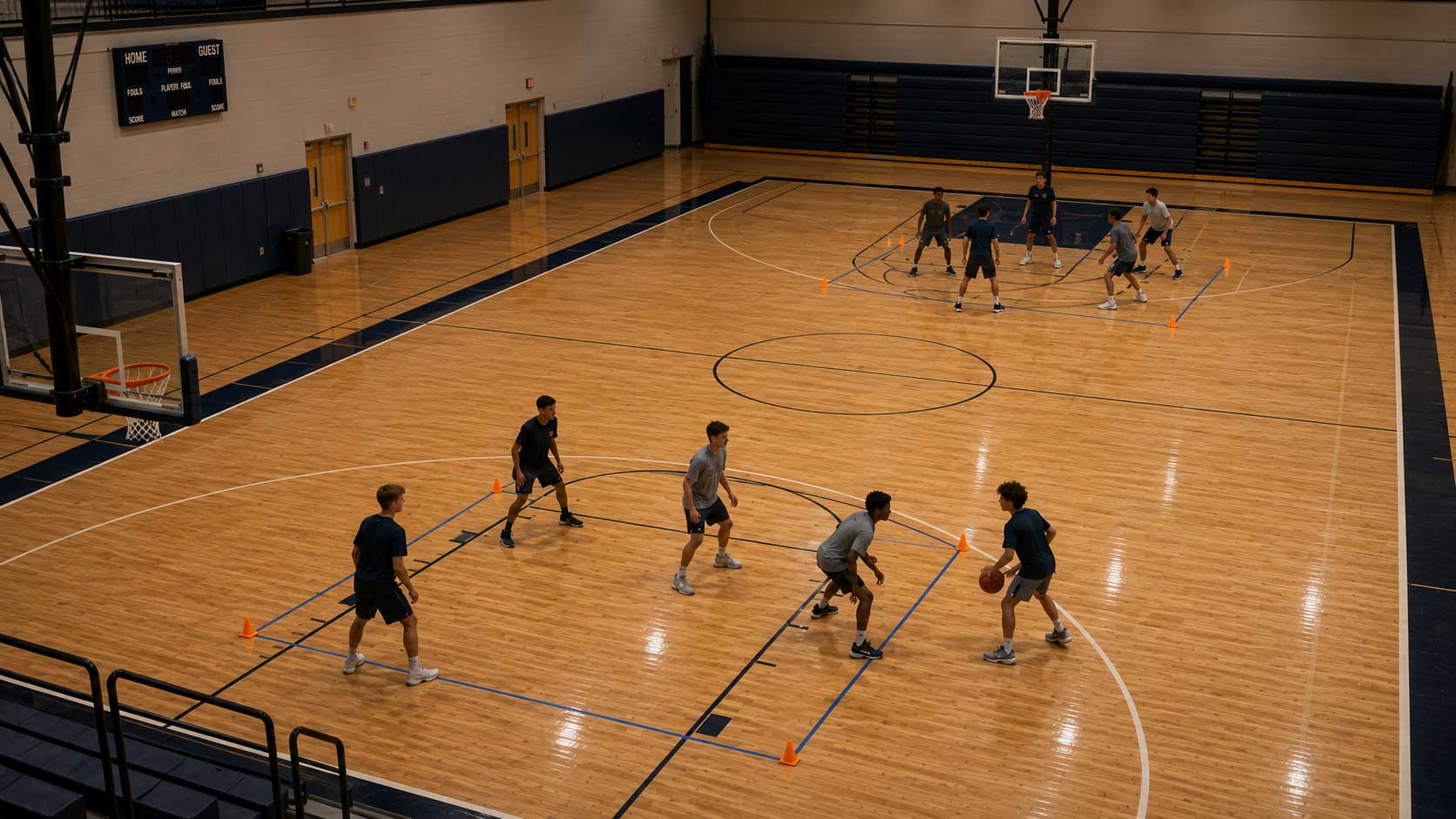
Table of contents
A practical framework for using small-sided games (1v1 through 4v4) as a constraint-based practice-design tool — which formats teach which reads, which constraints to manipulate, and common design mistakes, grounded in basketball-specific research and the constraints-led coaching approach.
Shrink a 5-on-5 possession down to 3-on-3, and something more than the player count changes. The spacing opens, the number of live decisions per minute climbs, and a player who might touch the ball twice in a full-court possession now touches it six or seven times. That shift isn't a side effect of a smaller game. It's the entire reason small-sided games work as a practice-design tool, not just a way to fit more repetitions into a short practice window.
Coaches have used reduced-numbers games for decades, often without a formal name for what they were doing. The constraints-led approach gives that instinct a framework: treat the size of the game, the space it's played in, and its scoring rules as levers a coach pulls on purpose, not just as a smaller version of the real thing. This guide covers how to use those levers deliberately — which formats teach which reads, which constraints to manipulate, and where small-sided games fit inside a season built around film review and measurable development.
Why this matters
A basketball-specific systematic review of small-sided games training in youth basketball players found that these formats produced physical adaptations comparable to dedicated conditioning work, while also creating far more opportunities for touches, decisions, and skill repetitions than an equivalent block of unopposed drilling. That combination — conditioning value plus decision density — is one of the more common reasons small-sided games have become a widely used tool across basketball development programs rather than a niche technique.
The theory underneath sits in a broader body of research on ecological dynamics and nonlinear pedagogy, most associated with researchers like Keith Davids and Ian Renshaw. This research isn't basketball-specific — much of it comes from general motor-skill and multi-sport literature — but the mechanism it describes applies directly to basketball practice design: players learn to perceive and respond to real constraints (space, numbers, time, a defender's positioning) rather than rehearsing a movement in isolation from the problem it's meant to solve. A 3-on-3 game asks a player to read spacing and help defense the way a real possession does. A cone drill asks a player to remember a sequence.
One widely cited example, drawn from youth soccer academy research rather than basketball, found that reducing a game from 8v8 to 4v4 increased passes, shots, and one-on-one match-ups per player far more than the raw math of fewer players on the floor would predict. The finding isn't basketball-specific, but it illustrates the general pattern basketball coaches rely on: shrinking the game multiplies the number of meaningful decisions each player has to make.
When to use small-sided games
Small-sided formats belong in almost every practice, but they carry particular weight at two points. Preseason and tryouts are a natural fit — with limited practice time and a roster still being evaluated, small-sided games surface decision-making and effort in a way a scripted drill line doesn't, and they let a staff see how a player reads a live situation before the season's habits are set. They're just as valuable mid-season, whenever film review turns up a specific, repeatable gap — a guard who doesn't see the roll man, a wing who drives into help — since a well-built small-sided game can isolate that exact read and give a player repeated live attempts at it.
How to build a small-sided game on purpose
Start with the constraint categories, not the format
The constraints-led framework separates the levers a coach can pull into three categories: task constraints (the rules of the game — a shot clock, a scoring bonus, a dribble limit), environmental constraints (the space, the court markings, the basket height), and individual constraints (a specific player's current skill level, fatigue, or role). Before picking a format, name the read you want a player to practice, then decide which category of constraint will produce it. A guard who needs to see the roll man faster doesn't necessarily need a new drill — the fix might be a rule that rewards a quick pocket pass, or a smaller space that puts the screener's defender in the guard's field of view sooner.
Match the format to the teaching purpose
- 1-on-1. Isolates footwork, angles, and finishing decisions without help defense to complicate the read. Best for early-stage skill work before a player is ready to process a full defense.
- 2-on-2. Introduces the simplest form of a help-and-recover defensive read and the simplest two-player offensive action — a pick-and-roll, a give-and-go. Most ball-screen and closeout teaching can start here before it's asked to hold up in a bigger game.
- 3-on-3. The most commonly used small-sided format in basketball-specific coaching research, largely because it's the smallest game that still requires full-floor spacing, help-side rotation, and multiple simultaneous reads.
- 3-on-2 and 4-on-3. Numbers-advantage games that isolate transition and advantage-recognition reads — teaching an offense to identify and attack a numbers edge before the defense can recover, and teaching a defense to contain an advantage rather than concede an easy score.
- 4-on-4. Close enough to a full possession to rehearse team-defense rotations and multiple-action offense, while still producing more touches per player than 5-on-5.
Manipulate the constraint, don't just referee the outcome
When a small-sided game isn't producing the read a coach wants, coaching sources working from a constraints-led approach point to changing the setup rather than repeating verbal instructions. A few examples coaches commonly use: shrinking the space to force faster decisions, awarding extra value for a pass to the weak side to reward ball movement, limiting dribbles to push early passing reads, or adding a short shot clock to simulate late-game pressure. Each of these changes what the game is actually asking a player to solve, which tends to produce the read more reliably than a coach calling out the answer on every possession.
Keep the game representative
A small-sided game only teaches what it actually resembles. Removing spacing rules, allowing unlimited resets, or playing without a shot clock in a format meant to teach transition decision-making can strip out the exact pressure the game was designed to create. Before running a small-sided game, it's worth checking that its rules still represent the game situation it's meant to stand in for — not just that it uses fewer players.
Common mistakes
- Running small-sided games without a specific teaching purpose. A 3-on-3 scrimmage with no constraint attached still builds conditioning and touches, but it isn't targeting a specific read the way a deliberately constrained game does. Naming the read first keeps the format from defaulting to open scrimmaging.
- Setting a constraint that's too difficult or too easy. A dribble limit or shot clock set too aggressively produces chaos with no learning; set too loosely, it produces no real decision at all. Watch the first few possessions and adjust before running the full set.
- Treating every small-sided game as interchangeable. A 2-on-2 and a 4-on-3 teach different reads. Picking the format for the read it's built to isolate, rather than for variety alone, keeps the session purposeful.
- Using small-sided games only for conditioning. These formats carry real physical-training value, but treating them purely as a fitness tool leaves the decision-making benefit on the table. The two goals aren't in conflict — they just require the same session to be coached for both.
- Not connecting the constraint back to what film showed. A small-sided game built without reference to a specific in-game pattern risks teaching a read the team doesn't actually need. The most useful small-sided games trace back to something a coach saw on film first.
How experienced coaches approach this
Coaches who use small-sided games well tend to treat the constraint the way a film-review session treats a clip: as a specific, named teaching point, not a general activity. They also tend to ask players to explain their own read during or right after a possession — "what did the defense give you there?" — rather than only delivering the correction themselves. That reflective-questioning habit, letting a player articulate the decision in their own words, tends to build the kind of pattern recognition a scripted correction can't reach on its own. It's the same principle behind Basketball IQ development more broadly: the read has to become the player's own, not just a rule they're following.
Connecting to player development
Small-sided games are one of the more direct ways to turn a film-review finding into a practice rep, which is why they sit squarely inside the review-film and assign-learning steps of Brightfield's eight-step development cycle — observe before correcting, review film objectively, clip teachable moments, deliver concise feedback, assign learning, confirm player understanding, measure improvement over time, repeat. A constraint built around the exact gap a film session identified gives a player repeated, live attempts at the specific read that's holding them back, and it gives a coach a clear behavior to track over the following weeks. For the broader framework this fits inside, see How to Design a Practice That Transfers to Games and Connecting Film Review to Practice Plans.
Where Brightfield fits
None of this requires a platform — coaches have been building small-sided games and manipulating constraints long before any software existed to track them. Brightfield Scope exists for staffs who want a specific film finding to route directly into a specific small-sided game or constraint, and then track whether the read it targeted actually shows up differently in the next game.
Frequently asked
Newsletter
Get the Brightfield Brief
Weekly coaching intelligence — film-review frameworks, player-development science, and practice-planning templates. No fluff.
Brightfield Scope
Take it to the film room
Brightfield Scope turns these frameworks into a workflow — review film, build clips, deliver feedback, and track who's actually engaging.
Author
Brightfield Editorial
Editorial Team
The Brightfield Basketball editorial team publishes frameworks for modern player development.
Related resources
Practice Planning
Connecting Film Review to Practice Plans
A teaching point from film only becomes development once it shows up in a practice plan — here's how to build that transfer into a coaching staff's weekly workflow.
ReadPractice Planning
How to Design a Practice That Transfers to Games
Clean-looking drills don't always show up on game night. Here's how to design practice around the same reads, pressure, and decisions players actually face in games.
ReadBasketball IQ
What Is Basketball IQ, and Can It Be Coached?
Basketball IQ isn't a trait a player is born with — it's domain-specific pattern recognition and decision-making, built through structured reps, film review, and reflective coaching questions.
Read