How to Design a Practice That Transfers to Games
Clean-looking drills don't always survive contact with a live defender. Here's how to build practices around the same reads and pressure a game actually demands.
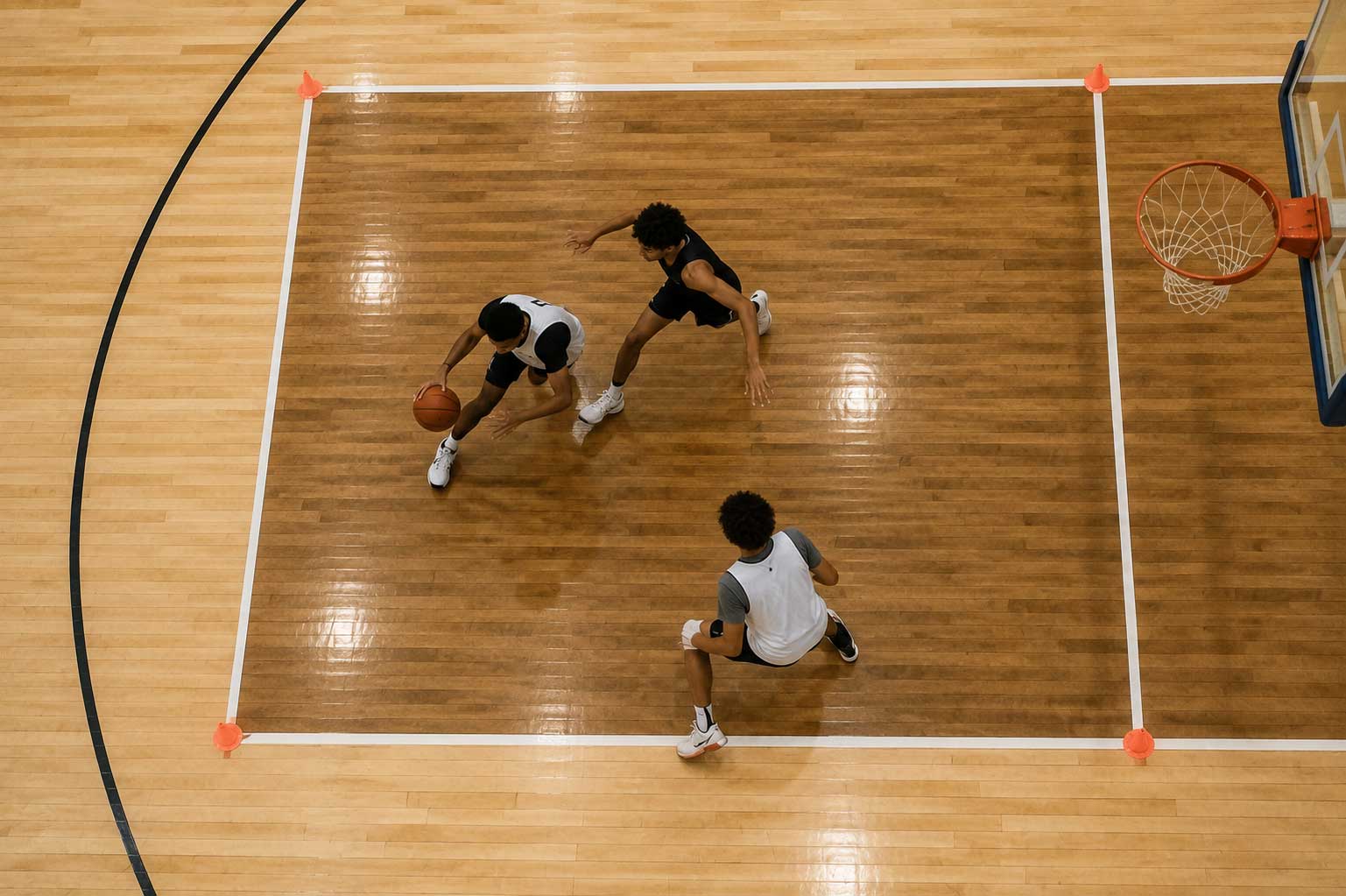
Table of contents
A practical framework for designing basketball practices that transfer to competition, built around representative learning design, constraint manipulation, and variable practice — with common design mistakes and a connection to Brightfield's film-review and development-cycle philosophy.
John Wooden planned every UCLA practice in writing, in advance, on index cards — not a rough outline, but each segment timed to the minute, with a plan for what would replace a drill the moment it stopped teaching something. Ten national titles later, the takeaway coaches usually draw from that habit is discipline for its own sake. We'd argue the real lesson is narrower and more useful: Wooden wasn't optimizing for how much his teams practiced. He was optimizing for what every single minute was actually teaching. That distinction — volume versus intent — is the whole argument of this guide, decades before the research existed to explain why it worked.
A player can look sharp in a drill line and still hesitate the first time a defender closes out for real. That gap between practice performance and game performance is one of the most common frustrations coaches raise, and it's rarely a sign the player needs more reps of the same drill. More often, it's a sign the drill never asked the player to read and decide in the first place. This guide lays out a framework for designing practices that hold up under game conditions — not by adding more volume, but by building the reads, pressure, and decision-making a game actually requires into the practice itself.
Why this matters
Skill-acquisition research points to a concept called specificity of practice: a skill trained under one set of conditions doesn't automatically transfer to a different set of conditions, even when the underlying movement looks similar. A catch-and-shoot rep against no defender and a catch-and-shoot rep against a live closeout are, from a learning standpoint, two different tasks — the second one requires reading a contest and deciding whether to shoot, pump-fake, or attack, and the first one doesn't ask for a decision at all.
Coaching sources describe the same pattern from the practice floor. A skill rehearsed against a cone or an empty spot on the floor gets tied to that cue — the cone, the line, the coach's whistle — rather than to what a defender's hips and hands are actually doing. When the game removes the cone and adds a live defender, the movement a player drilled a thousand times isn't available in a form the game can use. The player didn't lose the skill. They practiced a version of it the game doesn't ask for.
A practice plan built without those live reads is a bit like rehearsing scales without ever playing a phrase of music — it can sharpen isolated technique without ever building the skill of playing. Wooden's index cards weren't running this specific playbook — the constraints-led research below didn't exist yet — but the underlying instinct was the same: don't let a minute of practice pass without knowing exactly what it's supposed to build.
When to use this framework
This applies to any practice-planning cycle, but it matters most at two points in a season: preseason, when you're setting the habits and standards for how practice will run all year, and any stretch where film review keeps surfacing the same gap between what your team does in practice and what shows up in games. If you're heading into tryouts or the first weeks of practice, this is the right time to set the design principles below before old drill habits set back in.
How to design practice for transfer
1. Build the drill around a representative decision, not an isolated movement
Start by asking whether the drill asks a player to perceive something and respond to it — a defender's positioning, a teammate's cut, a closing gap — the way a game would. A shooting line with no defender removes that decision entirely. Adding even a passive defender at reduced intensity turns the same drill into a read: the shooter now has to register the contest and choose a response, which is the actual skill a game requires.
2. Use small-sided games to raise decision density
Formats like 2-on-1, 3-on-2, and 3-on-3 compress a practice window into far more meaningful decisions per minute than a full 5-on-5 possession or an unopposed drill line allows. Basketball-specific coaching sources built around this approach report that small-sided formats increase both the number of decisions a player makes per session and how directly those decisions resemble game situations, since the format keeps the ball, the defense, and the space all live at once.
3. Manipulate constraints instead of narrating instructions
Coaches working from a constraints-led framework distinguish between three levers: task constraints (the rules of the drill — a shot clock, a scoring rule, a space restriction), environmental constraints (the physical setup), and individual constraints (a specific player's current skill level or fatigue). Shrinking the space on a 2-on-2, adding a four-second shot clock, or awarding extra value for a drive-and-kick basket all nudge players toward a specific read without you having to call out the answer on every rep. When a drill isn't producing the read you want, the fix is usually a constraint, not a longer explanation.
4. Favor variable practice over repeating the same look
A body of general motor-learning research on what's called the contextual interference effect has found that mixing up skill variations within a practice session — rather than drilling one variation repeatedly before moving to the next — tends to slow performance during the session itself but improve retention and transfer afterward. This research is drawn mostly from general motor-skill and other-sport settings rather than basketball specifically, and basketball-specific studies on the effect are still limited, but the underlying mechanism — forcing a player to read and reconstruct a response rather than repeat one on autopilot — lines up with what representative, decision-based practice already asks for.
5. Let the solution vary from player to player
Two players finishing through contact rarely use the identical finish, and that's not a problem to correct. What matters is whether the movement a player finds solves the specific problem in front of them — the angle, the defender's hand, the space available — not whether it matches a single demonstrated technique. Coaching for a range of workable solutions, rather than one uniform model, tends to produce players who can adapt when the next possession looks slightly different.
Common mistakes
- Removing the defense to "clean up" a skill first. A defender-free rep teaches a movement the game will never present in that form; reintroduce a passive defender as soon as the base movement is safe to attempt under pressure.
- Overloading a drill with feedback instead of a constraint. Repeating "move the ball" every possession usually means the drill's rules don't reward ball movement; changing the scoring rule or the shot clock does the teaching a coach's voice can't.
- Blocking every rep of one skill before moving to the next. A full block of unopposed catch-and-shoot reps looks efficient in the moment but tends to fade faster than a session mixing shooting, driving, and passing reads together.
- Treating a messier-looking practice as a step backward. Decision-based practice produces more visible mistakes early on; watch for whether those mistakes shift over a few weeks from "didn't see the read" to "saw it, chose wrong, adjusted next time" rather than judging the session by how clean it looks.
- Scaling the constraint to the wrong level for the group. A constraint that's too difficult produces chaos with no learning, and one that's too easy produces no real decision at all; adjust the numbers, space, or defensive intensity until the read is present but solvable.
How experienced coaches approach this
Coaches who design consistently transferable practices tend to plan backward from a specific in-game read rather than forward from a list of drills — the same instinct behind Wooden's index cards, applied to a different unit of analysis. They ask what decision a player struggled with in the last game or film session, then build a small-sided game or constrained drill around that exact read, which is also where practice planning and film review should meet directly. For more on connecting a specific film finding to a specific practice segment, see Connecting Film Review to Practice Plans.
These coaches also tend to ask players to name their own read during a drill rather than only receiving a correction afterward — a small version of the reflective-questioning approach that shows up throughout Brightfield's film-review philosophy. A player who can say why they made a decision, in their own words, is closer to owning that decision on the next possession.
Connecting to player development
Practice design that transfers is one of the clearest links between a film-review finding and a measurable change in a player's game performance. It sits at the review-film and assign-learning steps of Brightfield's eight-step development cycle — observe before correcting, review film objectively, clip teachable moments, deliver concise feedback, assign learning, confirm player understanding, measure improvement over time, repeat — and it's the step where a teaching point stops being a note on a page and starts being a rep a player actually gets. A development timeline that tracks real progress depends on practices built to produce that transfer in the first place.
Where Brightfield fits
None of this requires software — coaches were building representative, constraint-based practices long before any platform existed to track them, and Wooden was writing his index cards decades before either. Brightfield Scope exists for staffs who want a film finding to route directly into a specific practice segment and then track whether the read it targeted actually shows up in the next game, closing the loop between what a session was designed to fix and what happened next.
Frequently asked
Newsletter
Get the Brightfield Brief
Weekly coaching intelligence — film-review frameworks, player-development science, and practice-planning templates. No fluff.
Brightfield Scope
Take it to the film room
Brightfield Scope turns these frameworks into a workflow — review film, build clips, deliver feedback, and track who's actually engaging.
Author
Brightfield Editorial
Editorial Team
The Brightfield Basketball editorial team publishes frameworks for modern player development.
Related resources
Practice Planning
Connecting Film Review to Practice Plans
A teaching point from film only becomes development once it shows up in a practice plan — here's how to build that transfer into a coaching staff's weekly workflow.
ReadBasketball IQ
What Is Basketball IQ, and Can It Be Coached?
Basketball IQ isn't a trait a player is born with — it's domain-specific pattern recognition and decision-making, built through structured reps, film review, and reflective coaching questions.
ReadPlayer Development
How to Build an Individual Player Development Plan
A general workout plan asks a player to "get better." An individual development plan names the exact habit, ties it to what the film shows, and sets a measurable checkpoint to track it.
Read