Connecting Film Review to Practice Plans
A teaching point only becomes development once it shows up in a drill. Here's how to build that transfer into a weekly coaching workflow.
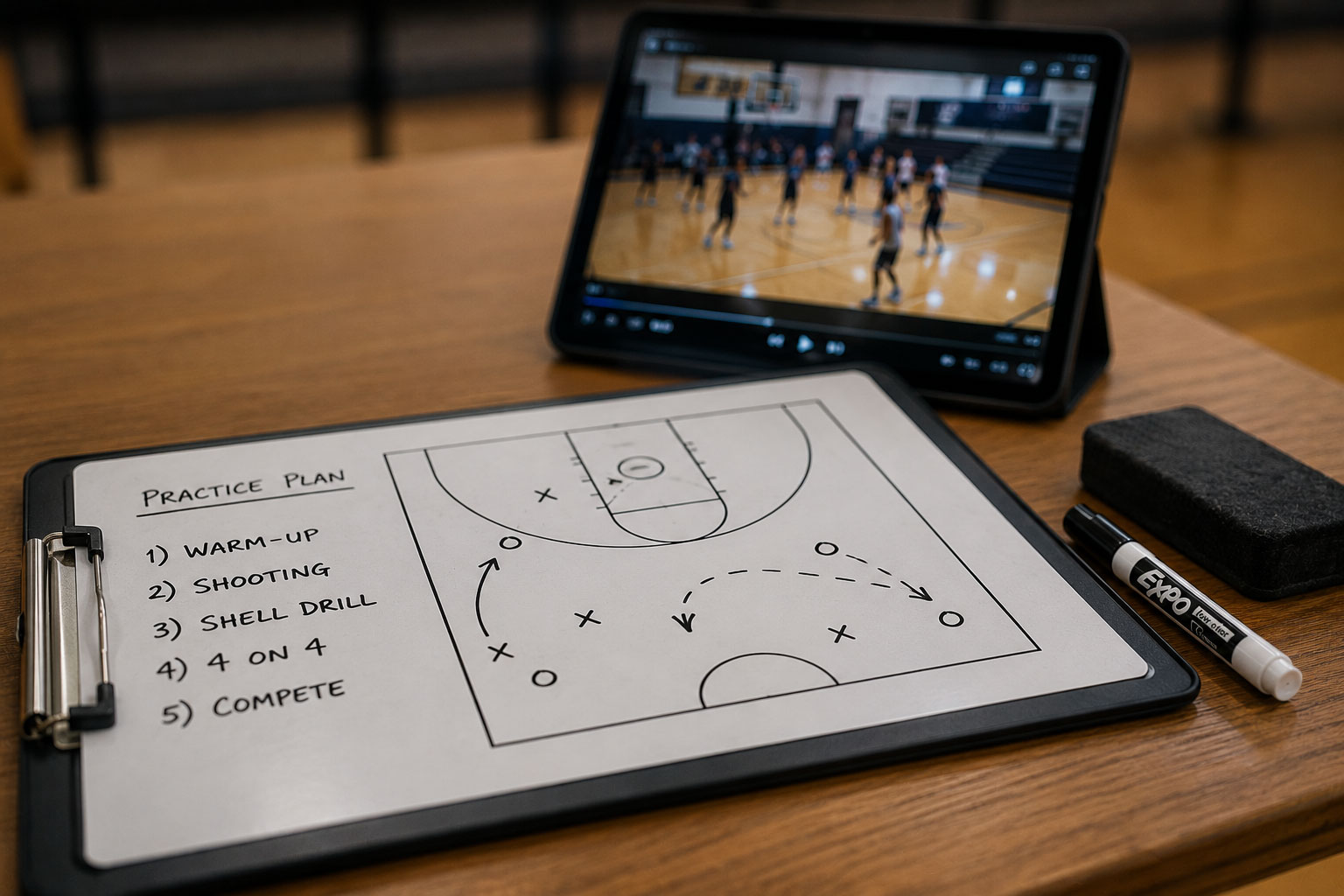
Table of contents
Film review and practice planning work best as one system, not two. This guide shows how to turn a reviewed clip into a specific practice segment, using Brightfield's eight-step development cycle and research on deliberate practice and constraint-based drill design.
If your film review and your practice plan are built by the same person in the same week but never actually reference each other, you're running two separate systems inside one program. You tag clips on Monday, then build Tuesday's practice plan from a template, last season's notes, or whatever feels most urgent in the moment. We think that gap — not a lack of film discipline — is where most otherwise-solid film-review work quietly stops paying off. A teaching point that lives only inside a video app doesn't change what happens on the floor. It becomes development only once you deliberately route it into a specific practice segment.
This guide picks up where our companion piece, How to Review Basketball Game Film, leaves off — at the assign learning step of Brightfield's eight-step development cycle — and walks through how to carry a reviewed clip into that week's practice plan.
Why this connection matters
Research on deliberate practice offers a useful frame for why this step matters. Anders Ericsson's original definition describes deliberate practice as individualized training built around a specific, well-defined goal, paired with immediate feedback and repeated attempts to close the gap between the goal and current performance. A film session is where that specific goal gets identified. Practice is where the repeated attempts happen. When the two aren't connected, neither half of that definition is complete on its own.
Coaching sources describe the same failure pattern from the practice-planning side. Breakthrough Basketball's practice-planning guidance recommends writing the exact game behavior a drill is meant to change at the top of the plan — a closeout angle, a help rotation, a shot-selection read — rather than listing drills by name alone. A film-review teaching point is often the cleanest source for that language, since it's already tied to a possession your team actually played.
When to make the connection
The natural transfer point is immediately after a film session that produces two or three clear teaching points, and before you draft the next practice plan. Making the connection close to the review keeps the correction tied to a specific possession your team remembers, rather than a general impression gathered over several weeks.
This applies at both scales. A single postgame film session can shape the next practice's first ten minutes. A recurring pattern across several games — a team consistently late on weak-side rotations, for example — can shape a full week's practice theme. Either way, write the practice plan after the film review, not before it, so it reflects what the film actually showed rather than a generic template.
How to translate film into a practice plan
1. Keep the review to what can become a drill
PGC Basketball's guidance on film sessions is to hold each one to two or three teaching points rather than covering every mistake on the tape. That same discipline serves practice planning directly — a review with three clear themes produces three specific practice emphases you can actually act on, instead of a long list that dilutes all of them.
2. Write the practice emphasis in the clip's own language
Carry the clip's label into the practice plan in close to the same words. If film review flagged a slow closeout on the strong side, the next practice plan should name that same read at the top of a segment — not a generic label like "defense" or "footwork" that loses the specific detail the film provided.
3. Build the drill around the constraint the film revealed
Motor-learning research increasingly favors small-sided, constraint-based games over isolated repetition for developing in-game decision-making. Much of this evidence comes from soccer and general skill-acquisition literature rather than basketball specifically, but the underlying mechanism — manipulating space, numbers, or scoring rules to force a specific decision — applies directly to translating a film finding into a drill. If film shows a player driving into help instead of reading the second defender, the fix is a small-sided drill built around that exact two-on-one or three-on-two read, not an unopposed repetition drill.
Basketball-specific coaching sources make a similar case. Writing on the constraints-led approach from Basketball Immersion describes manipulating space, numbers, or rules so the game itself produces the read a player needs more reps at, rather than isolating a skill and drilling it outside any decision-making context.
4. Assign the learning before the whistle blows
This step maps directly to assign learning, the fifth step in Brightfield's eight-step development cycle: observe before correcting, review film objectively, clip teachable moments, deliver concise feedback, assign learning, confirm player understanding, measure improvement over time, repeat. Attach every clip to a specific practice segment in writing, not just a verbal note to an assistant, so the connection between what a player watched and what they're about to do is explicit rather than assumed.
5. Name the connection out loud at practice
State the source of the drill at the start of the segment — "this is the closeout read from Saturday's film." Players who understand why a drill exists tend to engage with it differently than players running an unexplained drill. Naming the source also gives your assistants a shared reference point for what the rep is actually building toward.
Common mistakes
- Writing the practice plan before that week's film review happens. A plan drafted first reflects a template or a guess, not what your team's most recent film actually showed.
- Teaching points that never leave the film session. A correction delivered on video but never written into a practice plan tends to stay a comment rather than becoming a habit.
- Drilling a generic version of the skill instead of the specific read. Unopposed shooting reps don't address a decision-making problem the film identified in a live, contested possession.
- Assigning too many teaching points to too few practice minutes. Three or four corrections crammed into one session usually means none of them get enough repetition to stick.
- No way to confirm the correction transferred. Practice happens, but without tracking whether the read from film shows up in the next game, you have no way to know if the loop actually closed.
How experienced coaching staffs approach this
Staffs that run this well tend to treat film review and practice planning as one continuous workflow rather than two separate tasks handled by different people at different times. Whoever reviews film and whoever builds the practice plan work from the same short list of teaching points, in the same language, in the same week.
Several coaching sources also describe asking players to identify the read themselves during the drill, rather than only being told the correction — the same reflective-questioning approach Brightfield's film-review framework applies at the confirm-understanding step. A player who names their own read during a small-sided drill is practicing the decision, not just the movement.
Connecting to player development
A practice plan built on generic drills develops generic players. A practice plan built on that week's film develops the specific reads, habits, and decisions your team actually needs more reps at. Over a season, this is what separates a development timeline that shows real progression from a stack of practice plans that look similar in October and March.
This connection is also where individual and team development plans start to overlap. A player-specific correction from film can become an individual pre-practice routine, while a team-wide pattern can shape the group segment that follows it — both drawing from the same review instead of two disconnected processes.
Where Brightfield fits
This workflow runs fine on a whiteboard and a shared practice-plan template — coaching staffs did versions of it long before software existed for it. Brightfield Scope exists for staffs who want the film-tagging and the practice-planning steps to stay connected automatically, so a clipped teaching point can carry straight into your next plan instead of getting rewritten from memory.
Frequently asked
Newsletter
Get the Brightfield Brief
Weekly coaching intelligence — film-review frameworks, player-development science, and practice-planning templates. No fluff.
Brightfield Scope
Keep film review and practice planning connected automatically
Brightfield Scope carries tagged film teaching points straight into your weekly practice plan, so nothing gets rewritten from memory.
Author
Brightfield Editorial
Editorial Team
The Brightfield Basketball editorial team publishes frameworks for modern player development.
Related resources
Film Review
How to Review Basketball Game Film
A structured, eight-step framework for turning game film into measurable player development — observe, review, clip, deliver, assign, confirm, measure, and repeat.
ReadFilm Review
How Often Should Basketball Players Watch Game Film?
Quality beats quantity. Here's how to think about film frequency for player development.
ReadFilm Review
Basketball Film Review Checklist
A one-page checklist for running a structured film-review session with your team.
Read