What Is Basketball IQ, and Can It Be Coached?
Why pattern recognition and decision-making are trained skills, not fixed traits — and how structured film review and reflective questioning build them.
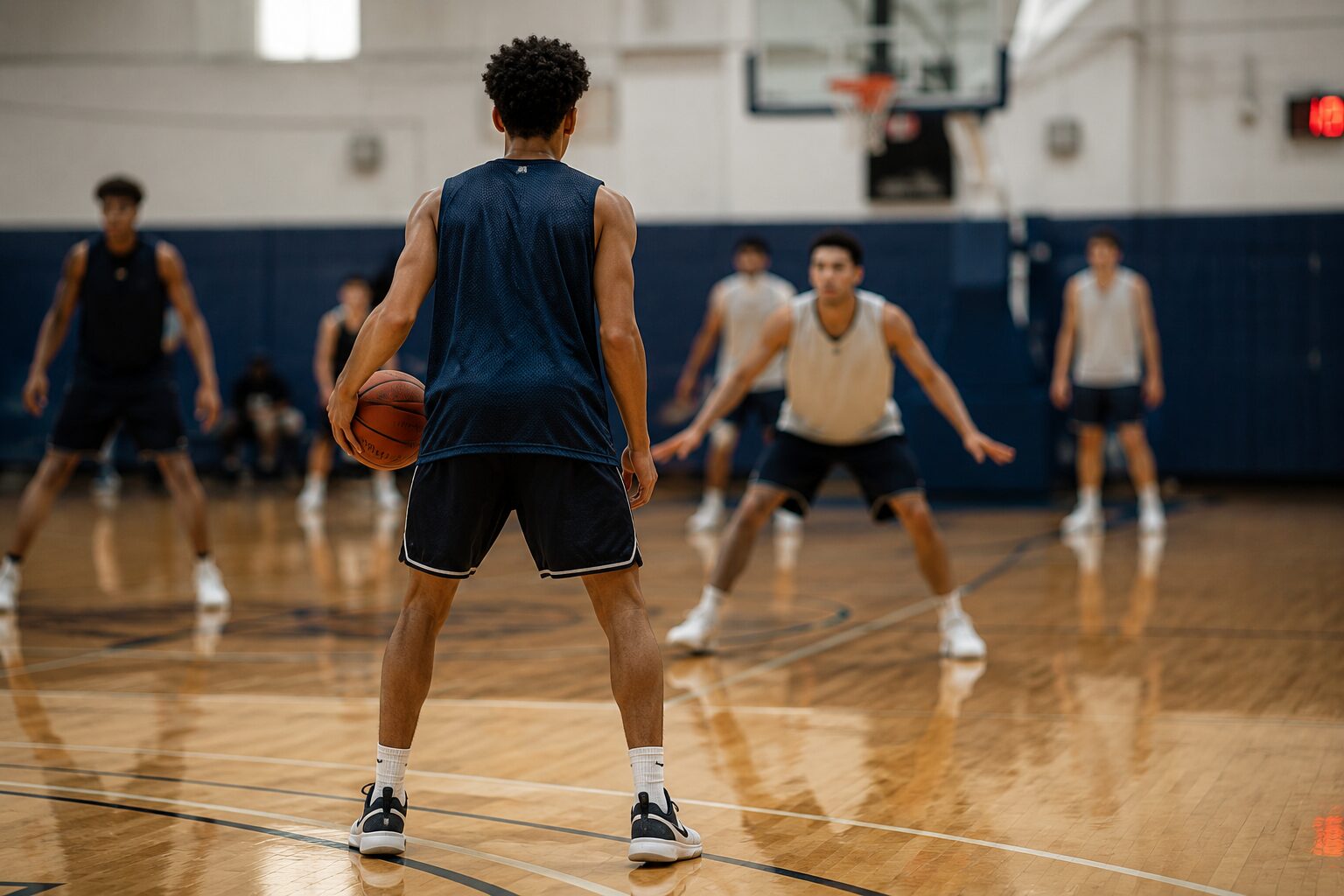
Table of contents
This cornerstone article defines basketball IQ as trained pattern recognition rather than a fixed gift, grounding the claim in classic chunking research (Chase & Simon, 1973), a basketball-specific pattern-recall study (Allard, Graham & Paarsalu, 1980), and coaching sources from Basketball Immersion and PGC Basketball. It connects the science to Brightfield's reflective-questioning philosophy and 8-step film-review cycle, and covers when to focus on IQ development, how it's built, common coaching mistakes, and how experienced coaches approach it.
During a 2013-14 playoff timeout, LeBron James stopped his own coach mid-huddle. Erik Spoelstra had drawn up a play on the whiteboard; James pointed at it and corrected the defensive alignment — "he has to be here, like this" — because he'd recalled exactly how that opponent had defended the same look in an earlier matchup. In a different game, James told his teammates, "let's do it this way, like we did in Game 3 against Dallas," referencing a coverage change from three years earlier. Spoelstra's reaction: "I was like, c'mon, that was from a game three years ago."
That's usually the story people reach for to explain basketball IQ as a gift — a near-photographic memory a player either has or doesn't. We think that's the wrong read of it. James's memory is unusual, but the mechanism behind it isn't mystical: it's a player's ability to read a live situation, recognize what it resembles, and choose a sound response before the defense fully commits. The research on how skilled performers actually process fast-moving information backs that up, and it says something more useful to a coach than "some players just have it."
What basketball IQ actually is
Basketball IQ describes a player's capacity to recognize meaningful patterns on the floor and select a decision that fits them — when to attack a closeout, when to reverse the ball, when a cutter's spacing has opened a driving lane. Sport-cognition research frames this as domain-specific pattern recognition, not general intelligence and not a fixed inherited quality.
The foundational study behind this framing comes from chess, not basketball. Chase and Simon (1973) found that expert chess players could recall complex, game-realistic board positions far better than novices, but that advantage disappeared when the same pieces were arranged randomly. Experts weren't remembering more pieces one by one — they were recognizing structured "chunks" built from years of exposure to meaningful positions.
A basketball-specific version of this finding exists. Allard, Graham, and Paarsalu (1980) studied experienced and less-experienced basketball players' ability to recall player positions shown briefly on video. Experienced players recalled structured, game-realistic formations more accurately than less-experienced players — but that edge shrank sharply when the same players were shown random, unstructured arrangements. The advantage tracked exposure to meaningful game patterns, not raw visual memory. That's the same mechanism behind James recalling a specific coverage from three years earlier and not, say, a random sequence of numbers: the memory is organized around structured, game-meaningful information.
That distinction is the evidence behind treating basketball IQ as a trained skill. The gap between a player who "sees the game" and a player who doesn't traces to how much structured, meaningful game information that player has been exposed to and asked to process — not to a ceiling on how the game clicks for them.
Why this distinction matters
Describing basketball IQ as fixed changes how you respond to a player who is struggling to read the floor. If the read gets treated as something a player "just doesn't have," the correction stops there. If the read gets treated as an underdeveloped pattern, the next step is obvious: more structured exposure to that specific situation, reviewed and discussed until the recognition speeds up.
It's also worth noting the trait framing doesn't hold up even at James's level. He's been candid that the same recall can work against him: "sometimes I cloud my mind too much. I get to thinking about the game too much instead of just playing." A trained pattern library isn't a switch that's always an advantage — it's a skill with its own failure mode, which is a very different thing from a fixed gift.
This is where Brightfield's position is direct. A player-development platform exists to build the habits, reps, and feedback loops that grow a skill across a season — not to hand a team a strategy and assume the players will absorb it on their own. Basketball IQ fits that model exactly. In this framework, it develops the same way a shot or a first step develops: through repetition, feedback, and reflection.
When coaches should focus on basketball IQ
Basketball IQ development belongs in nearly every phase of a program, but it earns focused attention in three common situations. First, when a player is technically skilled but slow to apply that skill live — the mechanics are there, the read isn't. Second, when a team executes drills well in practice but the same reads don't show up in games, which often signals the practice reps were too scripted to build real recognition. Third, at the individual level, when a player repeatedly makes the same suboptimal decision in a recurring situation, which usually points to one specific pattern that hasn't been reinforced yet, not a general shortfall.
How basketball IQ gets built
Structured, game-realistic reps
Pattern recognition builds fastest when practice reps resemble the structured situations players will actually see in games, not isolated drills with no decision attached. Constraint-based work — small-sided games, live reads against variable defensive pressure, drills where the offensive player has to choose rather than execute a pre-set move — gives players the "if this, then that" situations recognition is built from. This lines up with the broader deliberate-practice literature from motor-learning and cognitive research: unstructured repetition builds comfort with a motion, while structured, feedback-rich repetition against realistic variation is what builds a pattern library. That literature isn't basketball-specific, but the mechanism — meaningful, varied repetition paired with feedback — applies directly to how reads develop on the floor.
Film review as the pattern-recognition engine
Live reps move fast. Film slows the same situations down enough for a player to name what they saw, not just react to it. Coaching resources from Basketball Immersion and PGC Basketball both describe structured film review as the difference between a team that plays fast and a team that plays fast and smart — turning the film room from a passive viewing session into an active classroom where players write down what a defensive rotation looked like, what the spacing created, and what decision the read called for.
This is the direct link to Brightfield's film-review framework and its eight-step development cycle: observe before correcting, review film objectively, clip the teachable moment, and confirm the player can name the pattern before moving on. A possession clipped and reviewed twice, with the player asked to explain the read, builds recognition faster than that same possession played live a dozen times without any discussion attached to it.
Reflective questioning: ask before you tell
The fastest way to slow basketball IQ development is to answer for the player before the player has processed the situation. Coaches writing for Basketball Immersion have made this point directly: constant sideline instruction — shouting "shoot," "pass," "drive" — trains players to wait for direction instead of reading the floor themselves, and the pattern-recognition skill never gets the repetition it needs.
The alternative is asking before telling. "What did the defense do differently?" "What did you see there?" "Why did you make that pass?" These questions force the player to retrieve and describe the pattern rather than simply receiving the answer. Research on coach questioning practices in high-performance settings has found that guided, reflective questioning helps athletes build self-awareness and self-regulation around their own decisions — a mechanism consistent with how pattern recognition strengthens through repeated, structured recall.
Common mistakes coaches make
- Treating basketball IQ as fixed. Labeling a player as someone who doesn't have the IQ for a situation ends the coaching conversation before it starts. The fix: identify the specific recurring situation the player is misreading, and build reps around that pattern directly.
- Running only scripted drills. A drill with one correct outcome and no live decision doesn't build recognition, no matter how many times it's repeated. The fix: add a defensive read or a live constraint that forces a real choice.
- Over-instructing during live play. Calling out the answer before a player has to find it removes the exact rep that builds the skill. The fix: let the mistake happen, then review it afterward with a question instead of an immediate correction.
- Reviewing film without asking players to explain what they see. Passive film-watching teaches less than film paired with a question and a spoken or written answer. The fix: pause the clip and ask the player to name the pattern before revealing the outcome.
How experienced coaches approach this
Programs that build basketball IQ deliberately tend to share a few habits: they use film as a teaching tool rather than a highlight reel, they build practice around live decisions instead of only rehearsed sequences, and they ask more questions than they answer during breaks in play. PGC Basketball director Matt McLeod has built film sessions specifically around developing a playmaker's recognition speed, treating the skill as something built through structured study rather than something a player either brings to the gym or doesn't — the same underlying skill James was running on that whiteboard, just built through years of the same structured repetition available to any player willing to put in the film time.
"Don't just watch the game; learn to see what makes the game work." — Dick DeVenzio, quoted in PGC Basketball's coaching content on building a film culture
Connecting basketball IQ to player development
Basketball IQ isn't separate from the rest of a player's development plan — it's one of the clearest examples of why Brightfield treats development as a repeatable cycle rather than a single lesson. The same structure that improves a jump shot improves a read: observe the behavior, review it on film, clip the teachable possession, deliver a concise question or piece of feedback, confirm the player understands the pattern, and track whether the read improves over time.
Programs using Brightfield Scope apply this cycle to decision-making the same way they apply it to skill work, turning basketball IQ from a vague scouting-report label into a specific, trackable set of reads a player is actively developing.
Becoming a Playmaker: How to Improve Your Basketball IQ (PGC Basketball)
Frequently asked
Newsletter
Get the Brightfield Brief
Weekly coaching intelligence — film-review frameworks, player-development science, and practice-planning templates. No fluff.
Brightfield Scope
Run film-based basketball IQ development in Brightfield Scope
Clip the possessions that show a read, deliver them with a question instead of an answer, and track whether the pattern shows up faster over time.
Author
Brightfield Editorial
Editorial Team
The Brightfield Basketball editorial team publishes frameworks for modern player development.
Related resources
Film Review
How to Review Basketball Game Film
A structured, eight-step framework for turning game film into measurable player development — observe, review, clip, deliver, assign, confirm, measure, and repeat.
ReadFilm Review
How Often Should Basketball Players Watch Game Film?
Quality beats quantity. Here's how to think about film frequency for player development.
ReadFilm Review
Basketball Film Review Checklist
A one-page checklist for running a structured film-review session with your team.
Read