Where AI Actually Helps in Basketball Coaching (and Where It Doesn't)
A level-headed look at what AI-assisted film tools genuinely add to a coaching workflow — and where a coach's judgment still has to do the work.
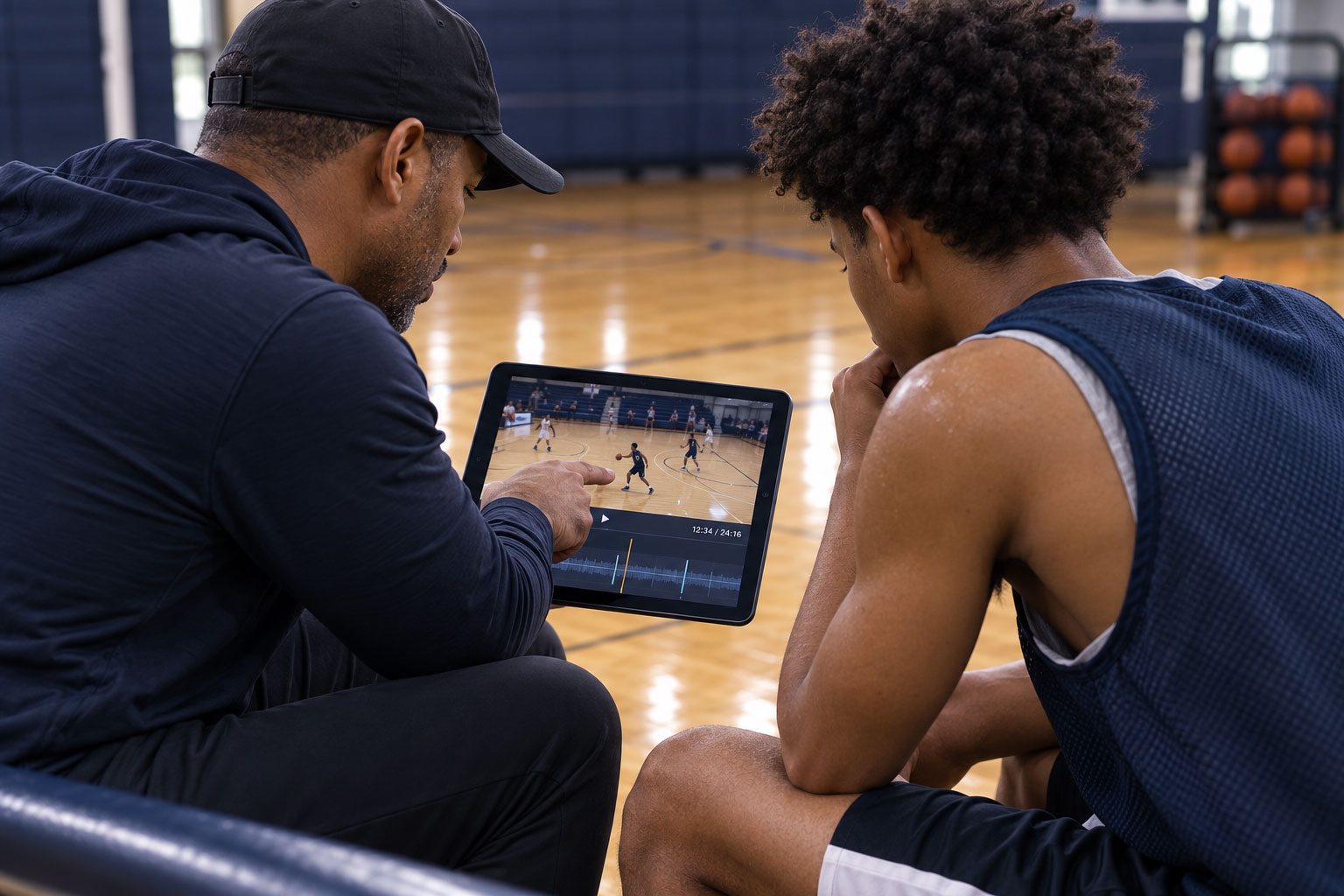
Table of contents
AI can scrub a full game and surface candidate teaching moments faster than a coach scrubbing alone, but it can't read intent, assign meaning, or replace the judgment that turns a clip into a correction.
Basketball coaching has picked up a new tool over the last few seasons: software that watches film faster than any staff can. Vendors describe it as tagging plays, flagging patterns, and condensing hours of footage into shorter reels of candidate moments. Some of that is genuinely useful. Some of it is oversold, and we'd rather tell you which is which than sell you the version where it's all upside.
The short version: AI is reasonably good at surfacing candidates for you to review. It cannot render a verdict on a player, and treating its output as a finished judgment — rather than a flagged possession waiting on your read — is where most of the real risk shows up.
Why this distinction matters
A flagged clip and a coaching correction are not the same thing. A flagged clip says: here is a possession that matches a pattern worth a second look. A correction says: here is what happened, here is what the player should do differently, and here is the next rep that proves it. Only you — watching the possession in context, knowing the scouting report, the player's history, and what was actually available on the floor — can make that second move responsibly. Skipping from flag to correction without that step is where automated tools can do real damage to a player's development record, even when the underlying pattern-detection was accurate.
What AI is actually good at right now
The clearest, best-supported use case is volume. Film-analysis platforms built for basketball can process a full game's worth of footage and automatically tag plays, possessions, and player actions, which lets you jump toward likely moments instead of scrubbing an entire game in real time. That's a meaningful time savings if you don't have a dedicated video coordinator, and it shows up consistently across the vendors and coaches describing their own workflows.
Pattern-flagging at scale is the specific strength worth naming: an algorithm doesn't get tired in the fourth quarter of game six, and it can consistently apply the same tagging criteria across every possession in a season. That consistency is a real advantage over a tired coach doing the same task by hand at midnight.
Where it runs out of road
The limitations aren't hypothetical, and they aren't really about the algorithms getting better next year — they're structural. A few show up repeatedly in how these systems are described by the people building and using them:
- Context and intent aren't visible in the frame. Two possessions can look nearly identical on tape — a live-ball turnover, a contested pass — while meaning completely different things depending on the coverage called, the read available, and what the player was trying to do. A system that tags the outcome (turnover) has no reliable way to tag the intent behind it. That gap is exactly where your judgment is still doing the real work.
- Complex, fast game states are harder to track reliably. Reporting on these tools has noted that single-camera systems, in particular, tend to perform more consistently in slower-paced games with clear spacing, and can struggle with rapid transitions, full-court pressure, and the dense half-court sets common in high school and college play. That's a real gap between marketing language and on-court performance, and it's worth your skepticism before trusting a tagged clip from a chaotic possession.
- Player identification and occlusion remain open technical problems. A broader research review of computer vision in sport points to player similarity, blurry footage, and partial or full occlusion as ongoing challenges for automated tracking — not solved problems, just improving ones.
- Nothing in the system knows this specific player. A pattern that reads as a concerning trend across five games might actually be a player working through a coached adjustment, or playing through a minor injury you already know about. You carry that context. A tagging system doesn't.
The candidate, not the verdict
The most useful mental model here is one increasingly recommended by people who work at the intersection of sports and data: the tool proposes, the coach disposes. An AI-generated observation is a candidate — something worth your attention — not a finished conclusion. A study on human-AI collaboration in coaching practice found that the large majority of coaches surveyed described human judgment as indispensable for contextualizing what an AI tool surfaces, positioning the technology as a complement to coaching expertise rather than a stand-in for it. That lines up with what shows up across the deliberate-practice literature more broadly, which is general performance-psychology research rather than basketball-specific: personalized, immediate feedback from someone who understands the athlete's context is a defining feature of practice that actually improves performance, not an optional add-on.
Separate research on how athletes and coaches perceive AI-driven coaching tools has found that athletes value the personalization these systems can offer, but continue to rely on human coaches for motivation, trust, and the kind of ethical and relational judgment a tool doesn't carry. That's consistent with Brightfield's own position, and we'll say it plainly rather than bury it in a caveat: an AI observation is a hedged candidate for you to confirm, adjust, or dismiss — never a verdict handed down about a player. Any product that markets its AI as more than that is overselling what the technology can actually do.
Where this fits in the film-review cycle
Brightfield's film-review framework runs on eight steps: observe before correcting, review film objectively, clip teachable moments, deliver concise feedback, assign learning, confirm player understanding, measure improvement over time, and repeat. AI-assisted tools are genuinely useful in the middle of that sequence — helping you review faster and surface candidate clips — but they don't belong at either end of it. The first step, observing a possession in full context before deciding what it means, and the sixth step, confirming a player's own understanding through a question rather than a label, are both judgment calls that depend on your read of a specific person in a specific moment. No tagging system does that work, and none should be asked to.
How experienced coaches approach it
Coaches who have integrated these tools into a real workflow tend to treat the output the same way they'd treat a manager's note ahead of a scouting report: worth a look, not worth skipping the tape. A flagged possession still gets watched in full before it becomes a teaching clip. A pattern the software surfaces across several games still gets checked against what you already know about that player before it turns into a conversation. The software changes how fast you get to the possession worth reviewing. It doesn't change who decides what that possession means.
Common mistakes
- Treating a tagged clip as a finished correction. A flagged possession still needs your context before it becomes feedback a player hears. The fix: watch the full possession, confirm the read, then build the correction.
- Letting player-facing feedback come straight from an algorithm's label. A player should hear your read on a possession, not a system-generated tag. Route every flagged clip through a coach before it reaches a player.
- Assuming every game situation is captured with equal reliability. Full-court pressure and transition-heavy stretches are the sequences most likely to be tagged imprecisely. Give those clips extra scrutiny before building a teaching point around them.
- Skipping the observation and confirmation steps because the tool sped up tagging. Faster clip-building doesn't shorten the judgment calls on either end of the review cycle. Keep both steps in place regardless of how the clips got surfaced.
- Assuming a multi-game pattern means what it looks like. A repeated tag across several games is worth a conversation, not an automatic conclusion. Check it against what you already know about that player before treating it as settled.
How this connects to player development
The value of any film-review tool, AI-assisted or not, is measured the same way: does it help turn what you notice into a change a player actually makes. A tool that surfaces candidate moments faster is worth using if it gives you more time to do the parts of the cycle that require judgment — confirming understanding, delivering feedback a player can act on, and tracking whether a correction shows up in the next game. It's worth abandoning the moment it starts replacing those steps instead of feeding them.
An AI-flagged possession is a candidate for a coach's attention. It becomes part of a player's development record only after a coach has watched it, confirmed what it means, and connected it to a next rep.
Where Brightfield fits
Brightfield Scope uses AI the same way this article describes it: to help you scrub film faster and surface candidate moments for review, never to hand down a verdict on a player. Every AI-surfaced observation in Scope is a starting point for your judgment, not a replacement for it.
Frequently asked
Newsletter
Get the Brightfield Brief
Weekly coaching intelligence — film-review frameworks, player-development science, and practice-planning templates. No fluff.
Brightfield Scope
See how Brightfield Scope uses AI
Candidate clips, surfaced fast, reviewed by a coach before they ever reach a player.
Author
Brightfield Editorial
Editorial Team
The Brightfield Basketball editorial team publishes frameworks for modern player development.
Related resources
Film Review
How to Review Basketball Game Film
A structured, eight-step framework for turning game film into measurable player development — observe, review, clip, deliver, assign, confirm, measure, and repeat.
ReadFilm Review
How Often Should Basketball Players Watch Game Film?
Quality beats quantity. Here's how to think about film frequency for player development.
ReadFilm Review
Basketball Film Review Checklist
A one-page checklist for running a structured film-review session with your team.
Read