How Often Should Players Watch Game Film?
Frequency matters less than focus — here's how to build a cadence that actually compounds.
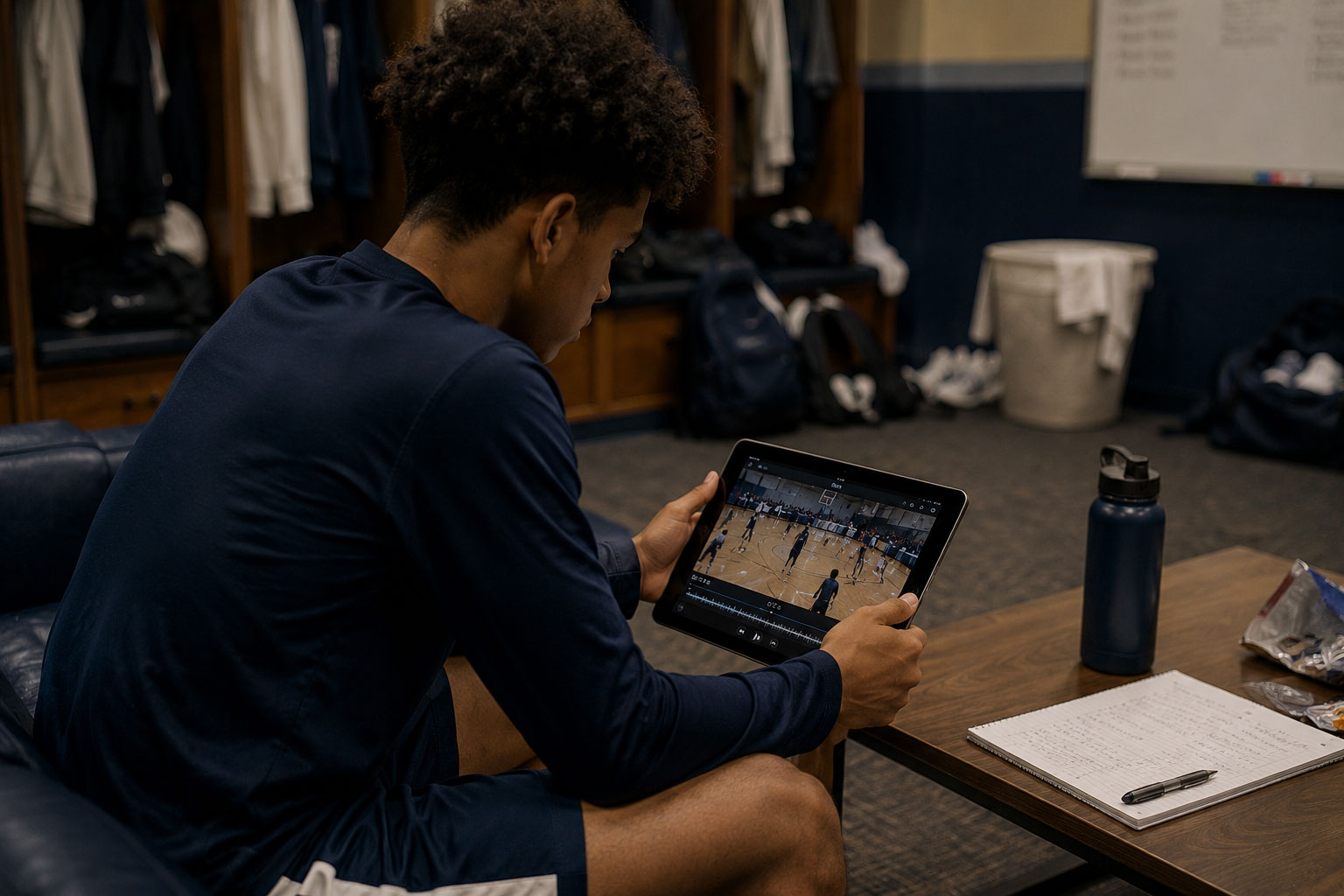
Table of contents
Two focused, tracked sessions a week outperform daily passive viewing — and the research on spaced practice explains why.
The right answer isn't a number — it's a standard. If you're asking "how many times a week," you're asking the wrong question. Film work only counts if it's focused and it's trackable. A player who watches an hour of unstructured highlights a night is doing less for their development than a player who watches ten focused minutes twice a week, and we'd bet on the second player every time.
Why frequency isn't the real question
Coaches often ask how many times a week players should watch film, expecting a number that will fix engagement on its own. But attention, not film, is the scarce resource. Two tracked, purposeful sessions beat daily passive viewing because the daily version usually has no thesis behind it — it's watching, not reviewing.
What the research says about spacing
This lines up with one of the more consistently replicated findings in learning science: distributed practice — spacing repetitions across multiple sessions — produces stronger retention than the same amount of repetition massed into one sitting. Some studies on skill and memory retention have found retention advantages of roughly 1.5 to 4 standard deviations for material reviewed across multiple sessions versus a single session.
That research isn't basketball-specific — most of it comes from general memory and motor-skill studies, not film review in team sports — but the underlying mechanism (spaced retrieval strengthens retention better than cramming) applies directly to how often your players should revisit the same read on film. A closeout read reviewed Monday and reinforced again Wednesday is more likely to hold than the same read watched once for twenty minutes straight.
A cadence that works for most in-season programs
There's no single correct schedule, but a simple two-session structure covers most of what you need:
- Session one — team review. Shortly after the game, while it's fresh. Focused on two or three team-level themes, not a full replay.
- Session two — individual clips. Mid-week, tied to each player's specific development goals rather than the team's collective result.
Off-season or individual skill work can run more frequently, since the sessions are shorter and more self-directed — a player reviewing their own shooting mechanics for five minutes after a workout is a different kind of session than a full team breakdown, and the frequency ceiling is higher because the cognitive load per session is lower.
Common mistakes
- Treating film as a volume metric. "We watch film every day" says nothing about whether any of it is focused or retained.
- No player role in the review. Research on self-controlled video feedback consistently finds that giving players some agency over when and what they rewatch improves both motivation and retention compared to a fully coach-directed schedule.
- No record of who watched. If you can't see who watched, you're guessing. In this framework, engagement is treated as the leading indicator that film work is translating to growth — not the number of sessions on the calendar.
- Treating every session as equally intense. A five-minute individual clip review and a full-team post-game breakdown aren't the same unit — don't schedule them the same way.
Make it measurable
Whatever cadence you land on, the more useful question isn't "how often" — it's "can I prove it happened, and can I see whether it's working." That means a record of what was assigned, whether it was watched, and whether the same read looks different two weeks later.
Ask before you tell
Whatever the cadence, each session goes further when you ask the player to self-report before telling them the correction: What did you see on this one? What would you do differently next time? A player who names their own read during a review is more likely to carry it into the next practice than one who's simply told what to fix.
Frequently asked
Newsletter
Get the Brightfield Brief
Weekly coaching intelligence — film-review frameworks, player-development science, and practice-planning templates. No fluff.
Author
Brightfield Editorial
Editorial Team
The Brightfield Basketball editorial team publishes frameworks for modern player development.
Related resources
Film Review
How to Review Basketball Game Film
A structured, eight-step framework for turning game film into measurable player development — observe, review, clip, deliver, assign, confirm, measure, and repeat.
ReadFilm Review
Basketball Film Review Checklist
A one-page checklist for running a structured film-review session with your team.
Read