Basketball Film Review Checklist
A one-page system for focused, measurable film sessions.
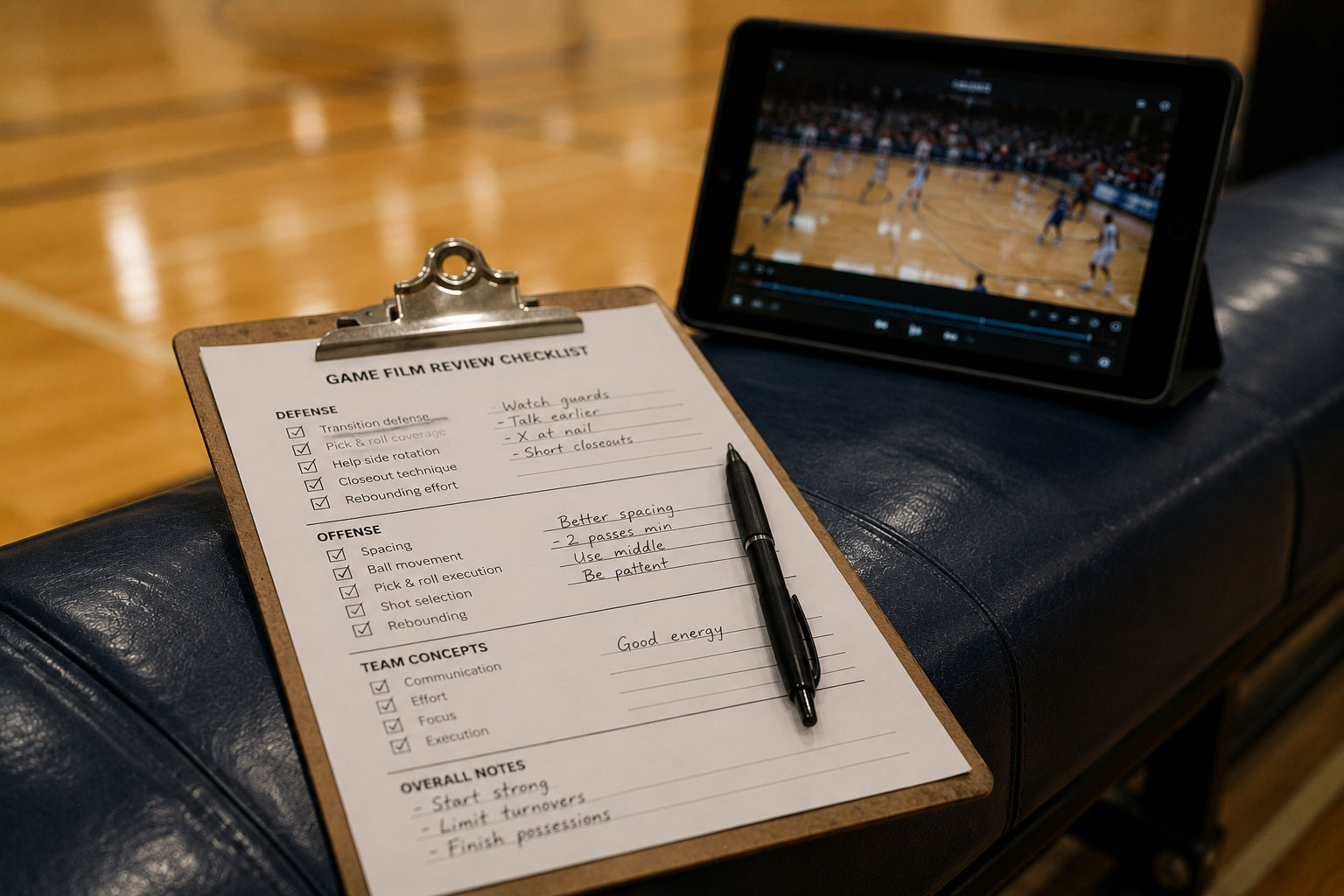
Print it, pin it, and run every film session against it.
A checklist doesn't replace your coaching judgment — it protects a session from drifting once the film starts rolling. Structured tasks with defined steps and built-in feedback loops are a core feature of deliberate practice, the framework most associated with reliable skill improvement. This checklist applies that same structure to a film session. Run through it before your next session; it's built to be printed or copied into your own weekly template, not read once and forgotten.
Pre-session
- Define two to three review themes. A session without a thesis turns into an undirected scroll through the game. Pick themes narrow enough to actually teach — "closeout angles in ball-screen coverage," not just "defense."
- Confirm the film is imported and queued. Logistics failures are a common reason sessions run short or get cut for time.
- Decide which clips need a player's own review before the group sees them. Giving a player a first look at their own clip supports the self-review habit that makes correction land better later in the session.
During session
- Tag possessions by theme, player, and outcome. Tag broadly as you watch — you can always narrow the final sequence later, but you can't retag what you didn't flag the first time.
- Build a five-to-eight clip teaching sequence. Shorter sequences with one point per clip outperform long, undifferentiated cut-ups — programs that publish their own film formats consistently favor concise, thematic sequences over full-game reviews.
- Lead positive, show correction, close with standard. Players who only see mistakes tend to disengage. This isn't about softening the correction — it's about sequencing so the feedback lands and holds.
- Ask before you tell. For each corrective clip, ask what the player saw before stating the read yourself. This is one of the habits that separates a film session from a lecture.
Post-session
- Deliver clips to players with development goals attached. A clip without an assigned adjustment is a highlight, not a teaching tool.
- Record engagement. If you can't see who watched, you can't connect the session to development. This is one of the most commonly skipped steps — and the one that makes every other step provable.
- Log one development note per player. A short, specific note beats a long vague one. Tie it to the next practice rep where possible.
Common mistakes this checklist prevents
- Starting the film with no defined themes, which turns review into reaction instead of teaching.
- Building a session that's all correction, which tends to erode trust in the feedback rather than build it.
- Ending a session with no record of who engaged, which makes it impossible to connect film work to what shows up on the court.
If you run this checklist for a month and it's still living in a browser tab instead of a repeatable process, that's usually a workflow problem, not a discipline problem — worth revisiting how film review connects to your practice plans.
Frequently asked
Newsletter
Get the Brightfield Brief
Weekly coaching intelligence — film-review frameworks, player-development science, and practice-planning templates. No fluff.
Brightfield Scope
Digitize this checklist in Brightfield Scope
Turn this one-page checklist into a repeatable workflow — tagging, clip-building, delivery, and engagement tracking in one place.
Author
Brightfield Editorial
Editorial Team
The Brightfield Basketball editorial team publishes frameworks for modern player development.
Related resources
Film Review
How to Review Basketball Game Film
A structured, eight-step framework for turning game film into measurable player development — observe, review, clip, deliver, assign, confirm, measure, and repeat.
ReadFilm Review
How Often Should Basketball Players Watch Game Film?
Quality beats quantity. Here's how to think about film frequency for player development.
Read