Building a Player Accountability System That Isn't Just Discipline
Accountability that lasts is a trained habit — naming your own reads, tracking assigned work, and following through over a season — not a consequence system.
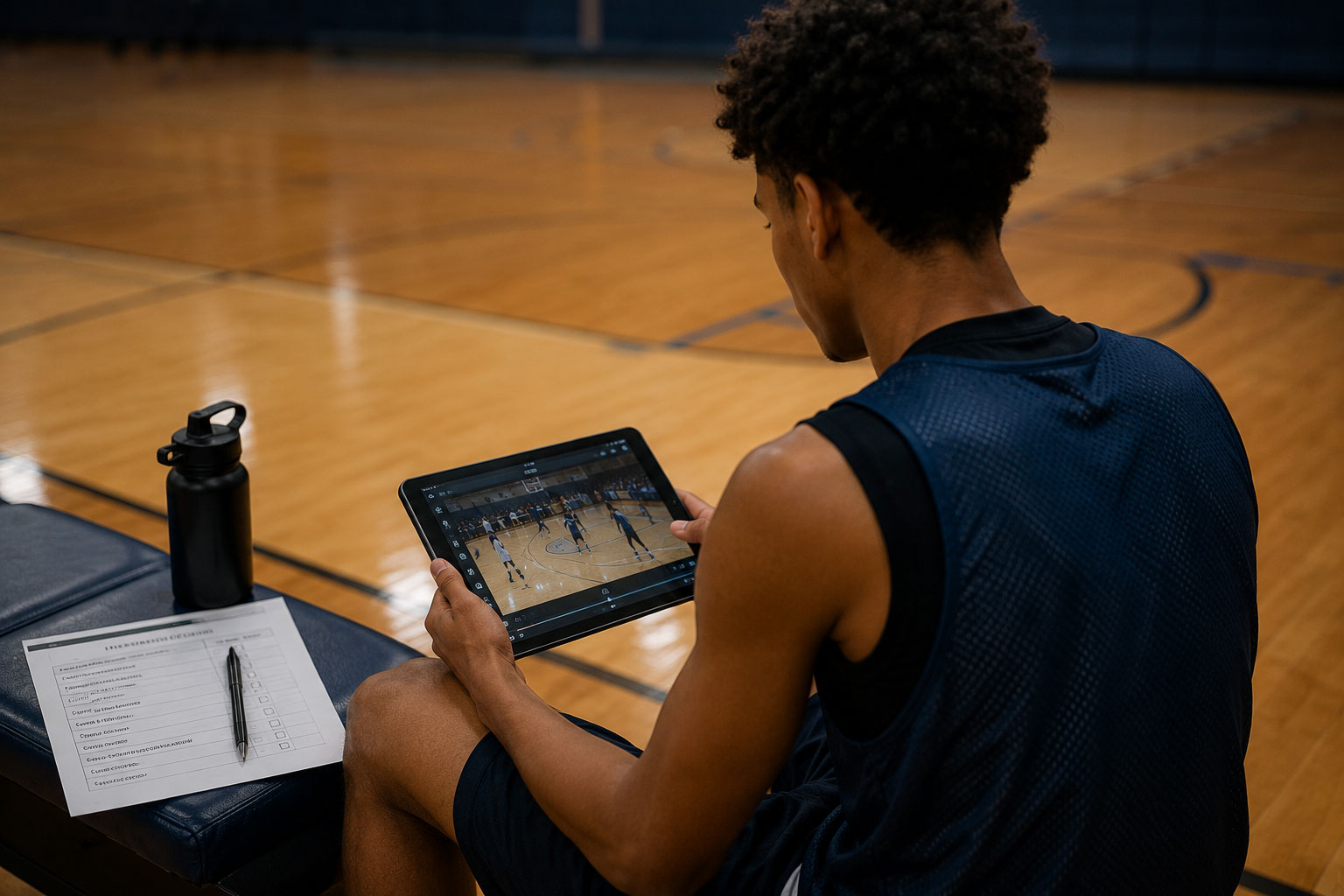
Table of contents
Reframes player accountability away from punishment and discipline toward three trainable habits: self-reporting reads during film review before being told, tracking engagement with assigned development work, and measuring follow-through on corrections across a season. Grounds the approach in self-regulated learning and self-determination theory research, and ties it to Brightfield's reflective-questioning philosophy and the 'Confirm player understanding' step in the 8-step development cycle.
You've said it in a staff meeting: "this team needs more accountability." What usually follows is a conditioning punishment, a benching, or calling someone out in front of the group — and we think that's the wrong lever. That version of accountability is really discipline wearing a different name, and it tends to produce compliance in the short term without building the habit you actually want: a player who catches their own mistakes before you have to point them out.
Accountability, defined this way, isn't a consequence system. It's a set of habits — naming your own reads, tracking your own assigned work, and showing measurable follow-through over a season — that you build deliberately, the same way you'd build a shooting form or a closeout technique.
Why this matters
Research on self-regulated learning in sport describes a cycle of planning, self-monitoring, and reflecting that athletes use to evaluate and adjust their own practice. Programs that give players real opportunities to self-monitor tend to see more consistent engagement with deliberate practice than programs where all evaluation flows one direction, from coach to player. That's a general finding from the sport-psychology literature on self-regulated learning, not a basketball-specific study, but the mechanism transfers directly: a player who is asked to name their own read before being told what happened is practicing the exact evaluative skill that shows up later, unsupervised, in a game.
Self-determination theory, a framework built by researchers Edward Deci and Richard Ryan and applied widely in sport psychology, identifies autonomy as one of three basic psychological needs tied to sustained motivation, alongside competence and relatedness. Coaching behaviors that support a player's sense of ownership over their own development — rather than behaviors that simply issue verdicts — are associated in this research with more durable, self-directed engagement. Punishment-based accountability systems tend to work against this: they locate ownership with the coach, not the player, which is the opposite of what the research suggests builds lasting habits.
When to use this
A structured accountability system matters most in three moments: during film review, when you ask a player to name a read or a decision rather than telling them first; during the period between sessions, when a player has been assigned specific film clips or reps to work on; and across a season, when you want to see whether corrections from October are still showing up — or not — in March. Each moment calls for a different mechanic, and all three are described below.
How it's done
1. Self-report before being told
In film review, the habit worth building is simple to state and harder to hold to: ask the player to describe the read or the decision before you narrate it. PGC Basketball's guidance on film sessions makes a related point — rather than always telling players what to look for, coaches get more out of a session by asking probing questions and, at times, letting a player lead the review. When a player says "I should have attacked the closeout instead of resetting" before you say it, that sentence is the accountability system working. It also does the diagnostic job you need: a player who can accurately name their own mistake understands it in a way that a player who is simply told the correction may not yet.
This connects directly to Brightfield's reflective-questioning philosophy — ask before you tell — and to the "Confirm player understanding" step in the 8-step development cycle. Confirming understanding is not a formality between "deliver feedback" and "assign learning." It's the checkpoint where you find out whether a player can self-report the correction, which is the clearest evidence that the correction has actually landed.
2. Track engagement with assigned work, not just outcomes
Once a player has been assigned clips to review or reps to run, the accountability question shifts from "did the read improve" to "did the player actually engage with the assignment." Research on athlete self-report monitoring tools notes that their value depends heavily on trust and a clearly communicated purpose — athletes disengage from tracking when they perceive it as a compliance check rather than a genuine part of their own development. The practical implication for your staff: track whether assigned film was watched and whether assigned reps were logged, and treat that tracking as information for a coaching conversation, not as a scorecard used to publicly rank players.
This is one of the more direct ways a workflow like Brightfield Scope supports this piece of accountability — logging whether assigned film and development tasks were completed gives you a factual, time-stamped record to start a conversation from, rather than a guess.
3. Measure follow-through over a season
The third layer is longitudinal: does a correction made in an October film session show up as a changed decision in a February game? This is where accountability stops being about any single conversation and becomes about a season-long record. A good habit under pressure is still a habit — which is exactly what you're checking for when you revisit the same clip type every few weeks: the same read, the same situation, watched for whether the decision has actually changed. Without that record, "he's more accountable this year" is a feeling; with it, it's a pattern you and the player can both see.
Shared ownership means everyone takes responsibility for the outcome — no blaming, no excuses. Film sessions and practices are for teaching, not for shaming a player in front of the group.
Common mistakes
- Treating accountability as a punishment lever. Positive Coaching Alliance has specifically criticized using conditioning as discipline, describing it as a habit that substitutes for actual coaching rather than building a skill. When "being accountable" only means "avoiding a consequence," a player has no reason to self-report a mistake — hiding it is the safer move.
- Overloading a single film session with corrections. PGC Basketball's guidance on film sessions recommends narrowing each session to a small number of teaching points, since a long list of corrections is harder for a player to retain or act on. An accountability system built on ten simultaneous corrections asks a player to track more than they reasonably can.
- Measuring effort instead of the actual read or habit. "Effort" is hard to verify and easy to dispute. A specific, time-stamped read — attacked the closeout on this possession, didn't on that one — is verifiable and gives both of you something concrete to track.
- Letting the record become public ranking. Tracking engagement and follow-through is a coaching tool, not a leaderboard. Once tracking is used to compare players publicly, players reasonably start managing the appearance of the record instead of the underlying habit.
- Skipping the confirmation step. Assigning a correction and moving on without confirming the player can restate it in their own words leaves you guessing whether the correction actually transferred.
How experienced coaches approach this
Coaches who build accountability systems that hold up over a season tend to share a few habits. They ask before they tell, particularly in film review, so a player has repeated practice naming their own reads. They keep a simple, consistent record of assigned work and whether it was completed, and they treat that record as a conversation starter rather than a verdict. They revisit the same corrections across the season instead of moving on after one conversation, which is what turns a single correction into a measured habit. And they separate the person from the possession in every conversation — the subject of a corrective sentence is always the read, the decision, or the habit, never the player's character.
How this connects to player development
Accountability, built this way, isn't a separate system bolted onto player development — it's what makes the rest of the 8-step development cycle durable. Observing and reviewing film objectively only matters if a player eventually starts doing that evaluation on their own. Assigning learning only produces change if you can confirm understanding and later measure whether the correction held. A player accountability system, in other words, is the mechanism that turns a single good film session into a season of compounding improvement — which is the same reason Brightfield's workflow starts with film review and treats accountability as a tracked, ongoing part of that same process rather than a separate disciplinary track.
If you want a structured way to track assigned film, confirm understanding, and measure follow-through across a season, you can see how that record-keeping works in practice with Brightfield Scope.
Frequently asked
Newsletter
Get the Brightfield Brief
Weekly coaching intelligence — film-review frameworks, player-development science, and practice-planning templates. No fluff.
Brightfield Scope
Track development, not just outcomes
See how Brightfield Scope helps coaching staffs log assigned film, confirm understanding, and measure follow-through across a season.
Author
Brightfield Editorial
Editorial Team
The Brightfield Basketball editorial team publishes frameworks for modern player development.
Related resources
Film Review
How to Review Basketball Game Film
A structured, eight-step framework for turning game film into measurable player development — observe, review, clip, deliver, assign, confirm, measure, and repeat.
ReadFilm Review
How Often Should Basketball Players Watch Game Film?
Quality beats quantity. Here's how to think about film frequency for player development.
ReadFilm Review
Basketball Film Review Checklist
A one-page checklist for running a structured film-review session with your team.
Read