Teaching Players to Read the Defense Before the Catch
Scanning is a habit built through constrained reps, film, and reflective questions. Here is how to coach it.
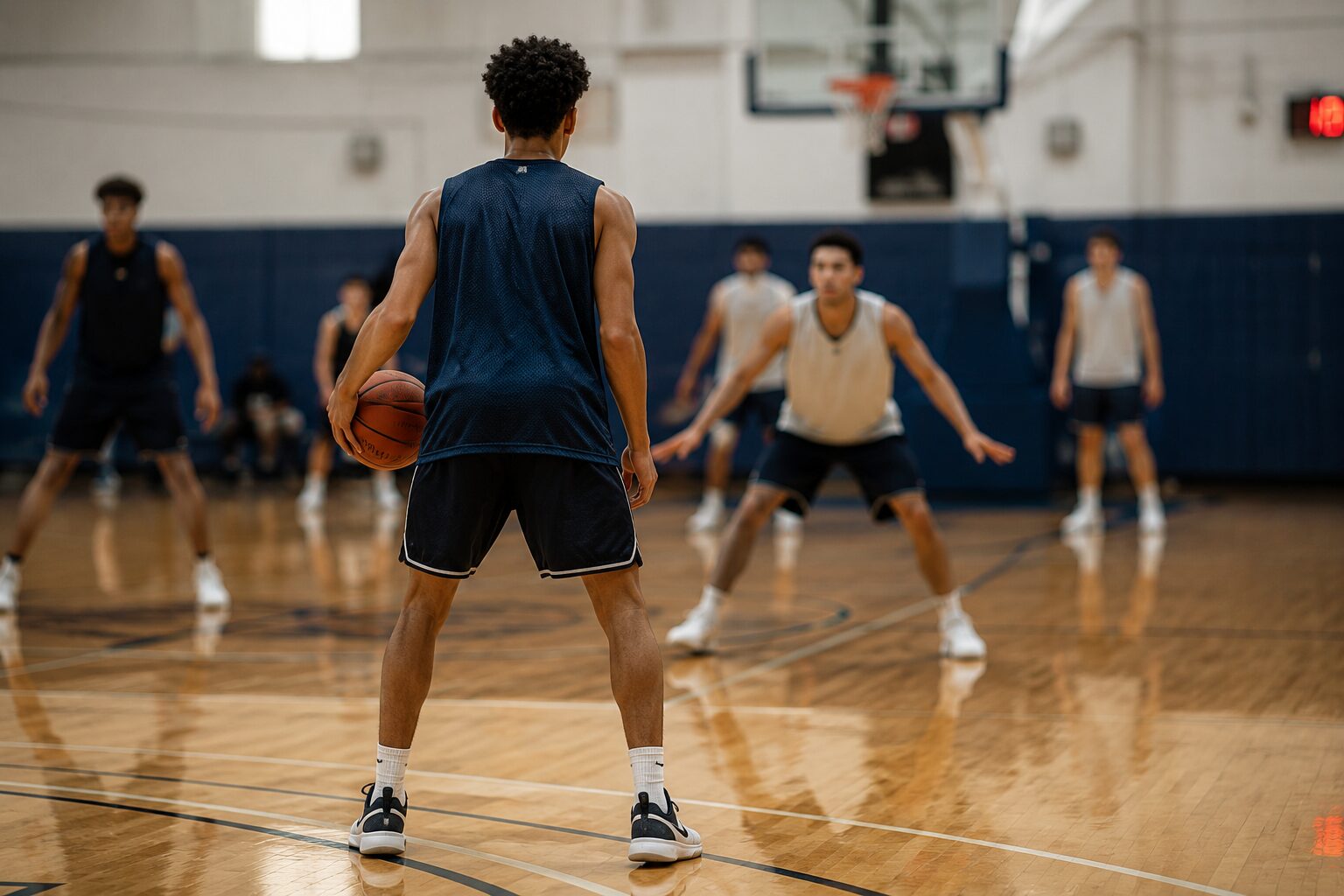
Table of contents
This article treats pre-catch scanning as a trainable habit rather than a fixed trait. It draws on a peer-reviewed scanning study in professional football (Jordet et al., 2020), basketball coaching resources from Basketball Australia and PGC Basketball, and Brightfield's film-review cycle. It covers why the read starts before the catch, when to coach it, how to build it with constraints, film and reflective questions, common mistakes, and how it connects to a player's development plan.
Many coaches have watched a player catch the ball, pause, and then look around. The pass or drive that follows may be technically sound, yet it arrives a half-second late because the information gathering started after the catch. The read the defense gave away was available earlier, and the player had not yet learned to look for it.
This article covers how to coach that earlier read. It treats scanning as a habit that develops through structured practice, film, and questions, in the same way a shooter develops a consistent pocket or a ball handler develops a change of pace.
Why the read starts before the catch
A player who first looks at the defense once the ball arrives has less time to choose. A player who has already noted where help sits, which defender is leaning, and where space is opening can use the catch to execute a decision rather than begin one.
Basketball Australia describes scanning as gathering information about teammates, defenders, and open space before, during, and after receiving the ball. Its feature also points to body position: a player squared to the sideline sees less of the floor than one who angles hips and shoulders toward the middle of the court. That is a practical, observable cue a coach can correct.
PGC Basketball makes a related point in its writing on mapping the floor. Telling a player to keep their eyes up is rarely enough, and the coach has to design practice that makes early scanning necessary.
What the research does and does not say
The most detailed scanning study we found is from football, not basketball. Jordet and colleagues (2020, Frontiers in Psychology) filmed 21 matches of one English Premier League club and analyzed 9,574 possessions. They defined scanning as an active head movement where the face is briefly directed away from the ball, and they counted scans in the ten seconds before a player received it.
Their model suggested that more scanning was associated with a higher chance of completing a pass. The authors describe the effect as small and positive, and they found that technical ability and pass difficulty mattered more. They also found less scanning under tight pressure. The data came from one club with a possession-based style, the coding was done by hand, and the club that partly funded the work employed some of the authors.
This is not basketball research, and the effect is modest. We include it because the mechanism is easy to carry over: a scan is a specific behavior a coach can see, count, and cue. The results should be read as support for coaching the habit, and not as proof that scanning alone produces better decisions.
When to use this in your program
- Early in the season, when you are setting shared language for what players look for on the catch.
- After a film session shows several possessions where the first useful look came after the ball arrived.
- When practice reps look clean but game decisions arrive late, which often means drills have not asked players to gather information first.
- With players moving up a level, where defenders close space faster and the time before the catch becomes more valuable.
How to build the habit
Teach a short scanning checklist
Give players two or three specific things to find before the ball reaches them, such as where the help defender is, whether the defender on the ball is leaning, and where the open space sits. A short list is easier to practice than a general instruction to see the floor. When a player knows what to look for, the head movement has a purpose.
Add a scanning demand to existing drills
Basketball Australia suggests building scanning into every drill rather than treating it as a separate exercise. Two simple additions from that feature work well: have a coach hold up fingers before a pass or shot and ask the player to call the number, or have the player read a cue before choosing the pass type. Each addition requires the player to look away from the ball before the catch.
Use small-sided games to make scanning necessary
Games such as 3v3 and 4v4 create more space and more defenders to track, which raises the value of early information. Constraint ideas worth trying include requiring a verbal call of the open teammate before each catch, or awarding a point only when the first pass after a catch goes to the player who was open before the ball arrived. See our guide to small-sided games and constraint-based practice design for how to set these up.
Review pre-catch moments on film
Film lets a player see what they looked at in the two seconds before the catch, which is difficult to recall from live play. Clip the moment slightly earlier than you normally would, so the player's head and eyes are visible. Pause before the catch and ask what they could see and what they expected to do. This is step three of Brightfield's development cycle, clipping teachable moments, applied to the part of the possession that usually goes unreviewed. The pillar article on how to review basketball game film covers the full cycle.
Ask before you tell
Questions are the most direct way to connect scanning to a player's own thinking. Examples: "What did you notice about the help defender before the pass came?" "Where was the space when you caught it?" "What would you want to see one second earlier next time?" Each question asks the player to describe what they saw and plan the next rep, which is the point of reflective questioning. Our article on reflective questioning goes deeper on the technique.
Common mistakes
- Cueing eyes up with no target. A general instruction gives the player nothing specific to find. Next rep: name the one or two things to look for before the catch.
- Treating a late read as a character issue. A late first look describes a habit that has not yet been trained. Next rep: describe the possession, then assign a drill with a scanning demand.
- Adding scanning only in isolated drills. A separate awareness drill may not carry over to live play. Next rep: attach the demand to a drill the team already runs.
- Reviewing film from the catch onward. The earlier part of the possession is where the habit shows up. Next rep: start the clip two to three seconds before the ball arrives.
- Expecting scanning to fix every late decision. The evidence suggests scanning contributes modestly, alongside technical skill. Next rep: check footwork and passing mechanics on the same clip.
How experienced coaches approach this
Coaches who develop this habit well tend to share a few patterns. They define the specific information they want players to gather. They build that demand into drills the team already runs. They praise a good early read even when the possession ends without a score, because the habit is what they are trying to grow. The PGC Basketball piece makes the same point about recognizing smart reads and early communication in post-game feedback.
They also keep expectations realistic. Pre-catch scanning improves over weeks of repeated, cued reps, and a player may scan well in a drill and revert in a game under pressure. The research above reflects this: scanning dropped under tight pressure. The coaching response is to revisit the habit with more game-like constraints, one rep at a time.
Connecting pre-catch reading to player development
A pre-catch read fits cleanly into an individual development plan. Pick one observable behavior, such as a scan toward the help side before a swing-pass catch. Clip a few possessions each week, ask one question per clip, and note whether the behavior appears earlier or more often. That follows the same development cycle used for any skill: observe, review, clip, deliver concise feedback, assign learning, confirm understanding, measure, repeat.
Programs using Brightfield Scope can tag these moments and compare them across a season, so the habit is tracked with the same care as a shooting mechanic.
Frequently asked
Newsletter
Get the Brightfield Brief
Weekly coaching intelligence — film-review frameworks, player-development science, and practice-planning templates. No fluff.
Brightfield Scope
Track pre-catch reads over a season in Brightfield Scope
Clip the possessions where a player's read began before the catch, pair each with a question, and track whether the habit shows up more often over time.
Author
Brightfield Editorial
Editorial Team
The Brightfield Basketball editorial team publishes frameworks for modern player development.
Related resources
Basketball IQ
What Is Basketball IQ, and Can It Be Coached?
Basketball IQ isn't a trait a player is born with — it's domain-specific pattern recognition and decision-making, built through structured reps, film review, and reflective coaching questions.
ReadBasketball IQ
Reflective Questioning: How to Get Players to Coach Themselves
Reflective questioning asks players to describe a read before the coach explains it. Here is what the coaching research says, how to sequence questions, and where the practice goes wrong.
ReadFilm Review
How to Review Basketball Game Film
A structured, eight-step framework for turning game film into measurable player development — observe, review, clip, deliver, assign, confirm, measure, and repeat.
Read