When Fear of Mistakes Holds Players Back
Some players hold back the exact plays they can clearly make in practice. Here's what that pattern looks like, and how to address it without labeling the player.
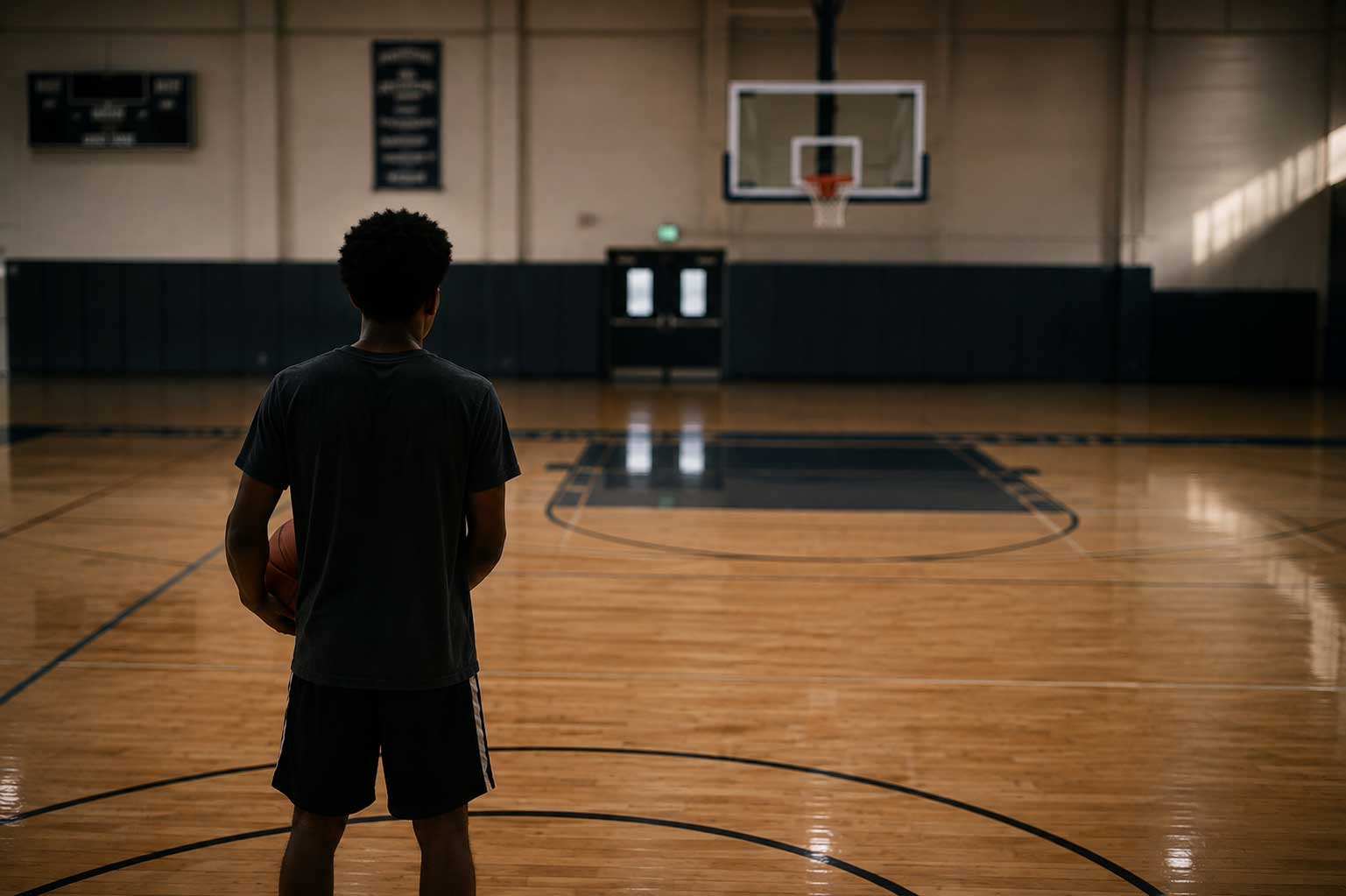
Table of contents
A research-grounded look at why some players underperform their skill level in games — tracing the pattern to evaluative coaching and parenting climates and to the conscious-processing effect described in performance-psychology research — with specific, practical guidance for how coaches can recognize and address it without labeling players.
A player catches the ball with a clean look at the rim, has taken that shot a hundred times in an empty gym, and instead pump-fakes and passes it away. Another dribbles out the shot clock on the wing rather than attempt a drive she can clearly finish. Neither play shows up as a turnover or a missed shot on the stat sheet, which is part of why the pattern is so easy for a coaching staff to miss. The player isn't lacking skill. Something is stopping the skill from showing up when it counts.
That gap — between what a player can do in practice and what they're willing to try in a game — often traces back to how mistakes have been treated in that player's history, not to their current ability. A player who has absorbed sharp, evaluative criticism from a previous coach or a parent after games tends to build a habit of avoiding the exact plays most likely to draw that criticism, even in an environment where nobody is currently criticizing them that way. This article covers what that pattern looks like on the floor and what a coaching staff can actually do about it.
Why this matters
Research on fear of failure in youth team-sport athletes has found that it isn't a fixed personality trait some players carry and others don't. Studies point instead to the motivational climate a young athlete has been raised and coached in — specifically, an environment that emphasizes outcome and evaluation over effort and improvement — as a strong predictor of fear-of-failure patterns. One study on youth team-sport athletes found that a parent-initiated climate weighted toward comparison and outcome was associated with higher fear of failure, while a climate emphasizing effort and mastery was associated with lower fear of failure and stronger basic psychological needs satisfaction (autonomy, competence, and connection to others).
The mechanism behind the on-court behavior has a separate, well-documented explanation in sport-science research on performance under pressure. Work associated with cognitive scientist Sian Beilock describes what's sometimes called the conscious-processing or explicit-monitoring effect: skills that have been trained to run automatically — a shooting motion, a first step off the dribble — break down when a performer starts consciously monitoring and controlling the mechanics in real time instead of trusting the trained movement. A player who is bracing for criticism after a mistake is, in effect, running that self-monitoring process throughout the game, which pulls attention away from reading the defense and toward managing the anticipated consequence of a miss.
This research is drawn mostly from general skill-acquisition and performance-psychology literature rather than basketball specifically, but the pattern it describes matches what coaches commonly observe: a player who is more afraid of the result of a mistake than focused on the read in front of them tends to play a smaller, more conservative version of their actual skill level.
What it looks like on the floor
- Passing up an open, in-rhythm shot that the player makes consistently in practice, especially late in a close game.
- Over-dribbling or over-passing to avoid being the player whose decision a mistake gets attributed to.
- A visibly different shooting or ball-handling motion in games compared to shootaround or individual workouts — more mechanical, more deliberate, less fluid.
- Checking the bench or the stands immediately after a missed shot or turnover, before the next possession has even started.
- A self-correction that's disproportionate to the mistake — a single travel or bad pass leading to several possessions of visibly cautious play afterward.
- Avoiding the ball in high-leverage moments — drifting away from a late-game possession a player would seek out earlier in the game.
None of these are effort or attitude problems, and treating them that way tends to make the pattern worse rather than better. They're closer to a trained response, and trained responses can be retrained.
How to address it
Confirm it's fear, not a skill gap, before addressing it as either
Compare how a player performs a specific skill in a low-pressure setting — an individual workout, an unopposed drill — against how the same skill shows up in a game. A meaningful gap between the two settings points toward a fear-driven pattern rather than a technical one. Treating a fear-driven pattern with more mechanical correction usually doesn't move the behavior, because the mechanics were never the problem.
Make the practice environment genuinely error-tolerant
A player rebuilding trust in their own decision-making needs live reps where a mistake doesn't trigger a visible reaction from the coaching staff. This doesn't mean lowering standards or skipping correction — it means separating the correction from anything that reads as evaluative judgment in the moment. Save the teaching point for a specific, calm follow-up rather than an in-the-moment reaction that a player braced for criticism will read as confirmation of what they expected.
Give feedback on the read, not the result
A player who passed up a good shot needs to hear that the decision to shoot was sound, separate from whether a shot taken later in the game goes in or out. Tying feedback to outcomes reinforces the exact evaluative link — good result equals good, bad result equals bad — that produced the fear pattern in the first place. Feedback built around the process and the read, delivered close to when the play happened, tends to rebuild a player's willingness to make the same decision again. This is the same behavior-focused approach covered in How to Deliver Corrective Feedback Players Actually Hear.
Address the parent relationship carefully, without assigning blame
Research on coaching style distinguishes autonomy-supportive coaching — which supports a player's sense of ownership over their own decisions — from controlling or intimidating coaching, which research associates with higher stress, lower motivation, and reduced sport commitment over time. A coach can't control what happens outside of practice and games, but modeling a consistently autonomy-supportive style is within a coach's control regardless of what a player has experienced elsewhere. Where a conversation with a parent is appropriate, framing it around what helps the player's decision-making and long-term development — rather than framing it as a critique of the parent's behavior — tends to be more productive and is more likely to be heard.
Use reflective questioning to rebuild ownership
Asking a player what they saw on a possession, rather than only telling them what they should have done, hands the decision back to the player instead of keeping it with the coach. This connects directly to Brightfield's broader film-review philosophy: a player who can name their own read out loud, in a setting without evaluative pressure, is rebuilding exactly the kind of decision-making ownership that a fear-of-failure pattern tends to erode.
Common mistakes
- Responding with reassurance alone. Telling a player "don't worry about it" after a hesitant possession addresses the moment but not the underlying pattern; it needs to be paired with specific, low-pressure reps that rebuild the decision.
- Labeling the pattern as a fixed part of who the player is. Framing a fear-driven pattern as something the player just needs to push through, rather than a learned response to feedback, tends to add another layer of evaluative pressure instead of removing one; the process-focused feedback and error-tolerant reps covered above address it more directly.
- Overcorrecting with excessive praise. Praise that isn't tied to anything specific can read as hollow to a player who is used to scrutinizing feedback for hidden criticism; specific, process-focused feedback tends to land better than general encouragement.
- Addressing it once and assuming it's resolved. A pattern built over multiple seasons of evaluative feedback usually takes more than one conversation or one game to shift; track the specific behavior over several weeks rather than expecting an immediate change.
- Skipping the conversation with the player entirely. Adjusting practice structure without ever naming the pattern to the player removes some of the pressure but skips the chance to build the player's own awareness of what's happening and why.
How experienced coaches approach this
Coaches who handle this well tend to talk openly about their own missed shots and misread plays, modeling that a mistake is a normal part of a live decision rather than something to hide from. They also tend to separate their in-the-moment reaction from their teaching — staying even-keeled when a mistake happens live, then addressing the read specifically and calmly afterward, often through film. That separation is what makes it possible for a player to trust that a mistake in the moment won't trigger the kind of reaction they may have learned to expect elsewhere.
Connecting to player development
This pattern is a clear example of why Brightfield's development cycle starts with observing before correcting: a coach who reacts to a mistake in the moment, rather than reviewing it objectively first, risks reinforcing the exact evaluative pressure that produced the pattern. Reviewing film together — pausing on the decision itself, not just the outcome — gives a coach a way to show a player their own good reads alongside the ones that need work, without the live-game pressure that tends to trigger a fear response. For the framework behind that approach, see How to Review Basketball Game Film and Growth Mindset in Basketball: What the Research Actually Supports.
Where Brightfield fits
None of this requires software to start — it starts with how a staff reacts to a mistake in the moment and how feedback gets delivered afterward. Brightfield Scope exists for staffs who want to track a specific behavior pattern like this one over time, connecting a film-review finding to the following weeks of games rather than relying on memory alone to tell whether it's actually changing.
Frequently asked
Newsletter
Get the Brightfield Brief
Weekly coaching intelligence — film-review frameworks, player-development science, and practice-planning templates. No fluff.
Brightfield Scope
Take it to the film room
Brightfield Scope turns these frameworks into a workflow — review film, build clips, deliver feedback, and track who's actually engaging.
Author
Brightfield Editorial
Editorial Team
The Brightfield Basketball editorial team publishes frameworks for modern player development.
Related resources
Sports Psychology
Growth Mindset in Basketball: What the Research Actually Supports
Carol Dweck's growth-mindset research gets cited constantly in coaching circles, often stripped of its context and its limits. Here is what the peer-reviewed evidence actually supports, what it doesn't, and how to apply the underlying mechanism in a basketball program without overselling it.
ReadCommunication
How to Deliver Corrective Feedback Players Actually Hear
The words a coach uses in the ten seconds after a mistake decide whether a player fixes the behavior or just braces for the next correction. A practical guide to reframing feedback around the play, not the person.
ReadFilm Review
How to Review Basketball Game Film
A structured, eight-step framework for turning game film into measurable player development — observe, review, clip, deliver, assign, confirm, measure, and repeat.
Read